| Indicator | Value |
|---|---|
| ISO 3166 alpha-2 | ATISO 3166 [2024] |
| ISO 3166 alpha-3 | AUTISO 3166 [2024] |
| Capital | ViennaGeoNames [2024] |
| Continent | EuropeGeoNames [2024] |
| Common name | AustriaCIA World Factbook [2025] · 2026 archive |
| Official name | Republic of AustriaCIA World Factbook [2025] · 2026 archive |
| Local name | OesterreichCIA World Factbook [2025] · 2026 archive |
| Etymology | the name Oesterreich means "eastern realm" and dates to the 10th century; the designation refers to the fact that Austria was the easternmost extension of Bavaria and the German peoples; the word Austria is a Latinization of the German nameCIA World Factbook [2025] · 2026 archive |
| Government type | Federal parliamentary republicCIA World Factbook [2025] · 2026 archive |
| Independence | no official date of independence: 976 (Margravate of Austria established); 17 September 1156 (Duchy of Austria founded); 6 January 1453 (Archduchy of Austria acknowledged); 11 August 1804 (Austrian Empire proclaimed); 30 March 1867 (Austro-Hungarian dual monarchy established); 12 November 1918 (First Republic proclaimed); 27 April 1945 (Second Republic proclaimed)CIA World Factbook [2025] · 2026 archive |
| National holiday | National Day (commemorates passage of the law on permanent neutrality), 26 October (1955)CIA World Factbook [2025] · 2026 archive |
| Head of state | Alexander VAN DER BELLEN (Pres.)CIA World Leaders [2025] |
| Currency code (ISO 4217) | EURISO 4217 Currency Codes [2026] |
| Currency | EuroISO 4217 Currency Codes [2026] |
| Administrative subdivisions | 9ISO 3166-2 Subdivisions [2026] |
| Subdivision names | Burgenland / Kärnten / Niederösterreich / Oberösterreich / Salzburg / Steiermark / Tirol / Vorarlberg / WienISO 3166-2 Subdivisions [2026] |
| Historical overview | Supercedes the 1976 ed. of Area handbook for Austria, coauthored by Eugene K. Keefe [et al.]. "Research completed December 1993." Includes bibliographical references (p. 273-286) and index. Also available in digital form.LoC FRD Country Studies [2026] |
| National symbols | eagle, edelweiss, Alpine gentianCIA World Factbook [2025] · 2026 archive |
| National anthem | title: "Bundeshymne" (Federal Hymn); lyrics/music: Paula von PRERADOVIC/Wolfgang Amadeus MOZART or Johann HOLZER (disputed); history: adopted 1947; Austria adopted a new national anthem after World War II to replace the former imperial anthem composed by Franz Josef HAYDN, which Germany had appropriated in 1922 and was thereafter associated with the Nazi regime; the Austrian Federal Assembly adopted a gender-neutral version of the lyrics in 2012; note: the beloved waltz "The Blue Danube" ("An der schoenen, blauen Donau"), composed in 1866 by Johann STRAUSS II, is widely considered Austria's unofficial national anthemCIA World Factbook [2025] · 2026 archive |
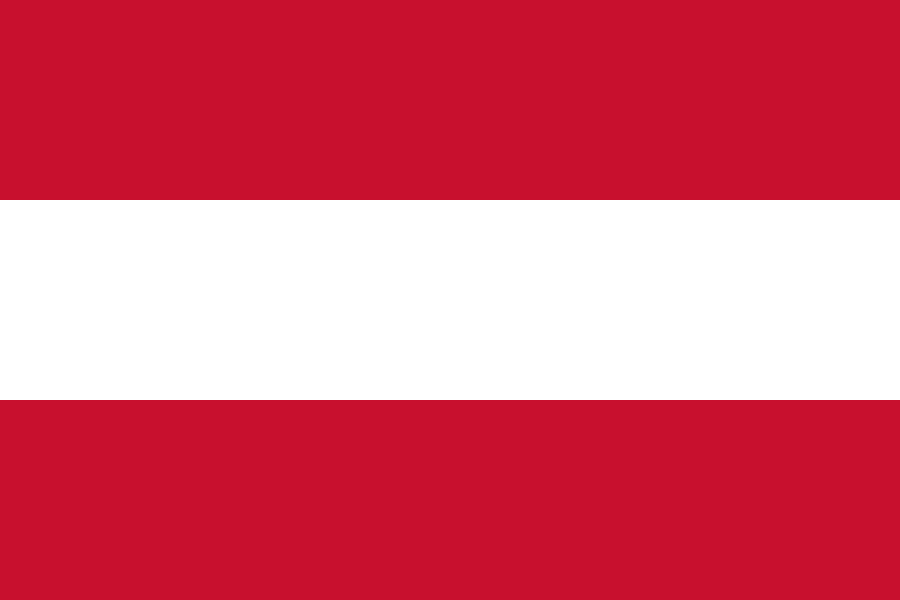
| National colors | red, whiteCIA World Factbook [2025] · 2026 archive |
| Citizenship rules | citizenship by birth: no; citizenship by descent only: at least one parent must be a citizen of Austria; dual citizenship recognized: no; residency requirement for naturalization: 10 yearsCIA World Factbook [2025] · 2026 archive |
the name Oesterreich means "eastern realm" and dates to the 10th century; the designation refers to the fact that Austria was the easternmost extension of Bavaria and the German peoples; the word Austria is a Latinization of the German name
description: three equal horizontal bands of red (top), white, and red history: one of the oldest national flags in the world; according to tradition, after a fierce battle in the Third Crusade in 1191, Duke Leopold V of Austria's white tunic became blood-spattered; when his sash was removed, a white band was revealed, and the red-white-red color combination was adopted as his banner
Source: CIA World Factbook (Historical Archive — final edition) · CC0 · Edition 2026-05