| Indicator | Value |
|---|---|
| ISO 3166 alpha-2 | DOISO 3166 [2024] |
| ISO 3166 alpha-3 | DOMISO 3166 [2024] |
| Capital | Santo DomingoGeoNames [2024] |
| Continent | North AmericaGeoNames [2024] |
| Common name | The DominicanCIA World Factbook [2025] · 2026 archive |
| Official name | Dominican RepublicCIA World Factbook [2025] · 2026 archive |
| Local name | La DominicanaCIA World Factbook [2025] · 2026 archive |
| Etymology | the name is a latinized form of the Spanish term Santo Domingo, meaning "holy Sunday;" Spanish explorers originally settled the island on a Sunday in 1496, and the name was first given to the island of Hispaniola as a whole in 1697CIA World Factbook [2025] · 2026 archive |
| Government type | Presidential republicCIA World Factbook [2025] · 2026 archive |
| Independence | 27 February 1844 (from Haiti)CIA World Factbook [2025] · 2026 archive |
| National holiday | Independence Day, 27 February (1844)CIA World Factbook [2025] · 2026 archive |
| Head of state | No authoritative open source found |
| Currency code (ISO 4217) | DOPISO 4217 Currency Codes [2026] |
| Currency | Dominican PesoISO 4217 Currency Codes [2026] |
| Administrative subdivisions | 10ISO 3166-2 Subdivisions [2026] |
| Subdivision names | Cibao Nordeste / Cibao Noroeste / Cibao Norte / Cibao Sur / El Valle / Enriquillo / Higuamo / Ozama / Valdesia / YumaISO 3166-2 Subdivisions [2026] |
| Historical overview | "Research completed December 1999." Supercedes the 1991 ed. of Dominican Republic and Haiti : country studies, edited by Richard A. Haggerty. Includes bibliographical references (p. 517-555) and index. Also available in digital form.LoC FRD Country Studies [2026] |
| National symbols | palmchat (bird)CIA World Factbook [2025] · 2026 archive |
| National anthem | title: "Himno Nacional" (National Anthem); lyrics/music: Emilio PRUD'HOMME/Jose REYES; history: adopted 1934; also known as "Quisqueyanos valientes" (Valiant Sons of Quisqueye); the anthem refers to the Dominican people as Quisqueyanos, which comes from the ethnic name for the islandCIA World Factbook [2025] · 2026 archive |
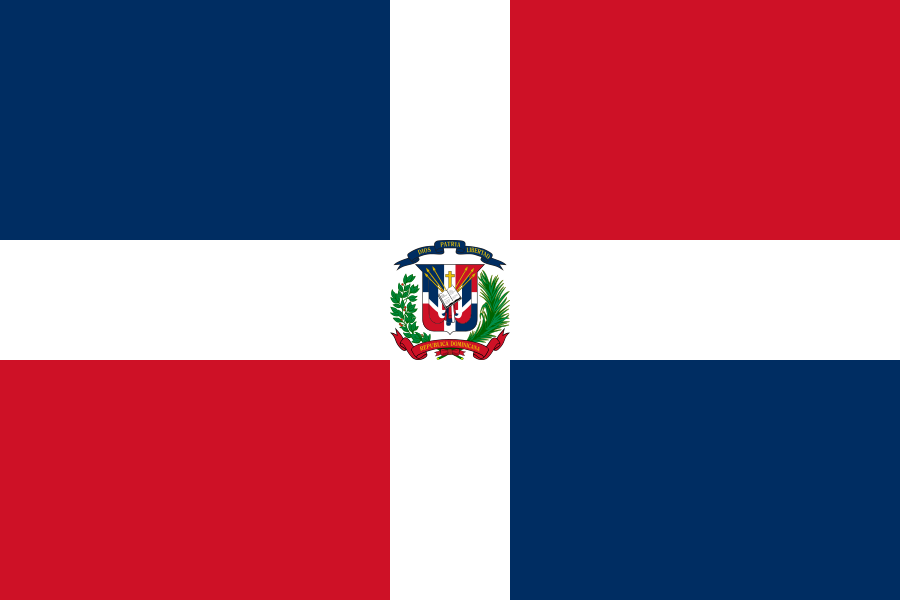
| National colors | red, white, blueCIA World Factbook [2025] · 2026 archive |
| Citizenship rules | citizenship by birth: no; citizenship by descent only: at least one parent must be a citizen of the Dominican Republic; dual citizenship recognized: yes; residency requirement for naturalization: 2 yearsCIA World Factbook [2025] · 2026 archive |
the name is a latinized form of the Spanish term Santo Domingo , meaning "holy Sunday;" Spanish explorers originally settled the island on a Sunday in 1496, and the name was first given to the island of Hispaniola as a whole in 1697
description: a centered white cross extends to the edges and divides the flag into four rectangles; the top ones are ultramarine blue (left side) and vermilion red, and the bottom ones are vermilion red (left side) and ultramarine blue; a small coat of arms with a shield supported by a laurel branch and a palm branch is at the center of the cross; above the shield, a blue ribbon displays the motto DIOS, PATRIA, LIBERTAD (God, Fatherland, Liberty); below the shield, REPUBLICA DOMINICANA is on a red ribbon; on the shield, a Bible is opened to a verse that reads "Y la verdad nos hara libre" (And the truth shall set you free) meaning: blue stands for liberty, white for salvation, and red for the blood of heroes
Source: CIA World Factbook (Historical Archive — final edition) · CC0 · Edition 2026-05