| Indicator | Value |
|---|---|
| ISO 3166 alpha-2 | EGISO 3166 [2024] |
| ISO 3166 alpha-3 | EGYISO 3166 [2024] |
| Capital | CairoGeoNames [2024] |
| Continent | AfricaGeoNames [2024] |
| Common name | EgyptCIA World Factbook [2025] · 2026 archive |
| Official name | Arab Republic of EgyptCIA World Factbook [2025] · 2026 archive |
| Local name | MisrCIA World Factbook [2025] · 2026 archive |
| Etymology | the English name Egypt derives from the ancient Greek name for the country, "Aguptos," and the ancient Roman name, "Aegyptus," with the Greek form coming from the words aia gupos, or "land of the vulture;" the Arabic name for the country, Misr, can be traced to the Assyrian word misir, meaning "fort"CIA World Factbook [2025] · 2026 archive |
| Government type | Presidential republicCIA World Factbook [2025] · 2026 archive |
| Independence | 28 February 1922 (from UK protectorate status; the military-led revolution that began on 23 July 1952 led to a republic being declared on 18 June 1953 and all British troops withdrawn on 18 June 1956); note: the Two Lands of Upper (southern) and Lower (northern) Egypt were first united politically around 3200 B.C.CIA World Factbook [2025] · 2026 archive |
| National holiday | Revolution Day, 23 July (1952)CIA World Factbook [2025] · 2026 archive |
| Head of state | Abdelfattah ELSISI (Pres.)CIA World Leaders [2025] |
| Currency code (ISO 4217) | EGPISO 4217 Currency Codes [2026] |
| Currency | Egyptian PoundISO 4217 Currency Codes [2026] |
| Administrative subdivisions | 27ISO 3166-2 Subdivisions [2026] |
| Subdivision names | Ad Daqahlīyah / Al Baḩr al Aḩmar / Al Buḩayrah / Al Fayyūm / Al Gharbīyah / Al Iskandarīyah / Al Ismā'īlīyah / Al Jīzah / Al Minyā / Al Minūfīyah / Al Qalyūbīyah / Al Qāhirah / Al Uqşur / Al Wādī al Jadīd / As Suways / Ash Sharqīyah / Aswān / Asyūţ / Banī Suwayf / Būr Sa‘īd / Dumyāţ / Janūb Sīnā' / Kafr ash Shaykh / Maţrūḩ / Qinā / Shamāl Sīnā' / SūhājISO 3166-2 Subdivisions [2026] |
| Historical overview | "Research completed December 1990." Supercedes the 1983 ed. of Egypt : a country study, edited by Richard F. Nyrop and issued by Foreign Area Studies, American University. Includes bibliographical references (p. 369-391) and index. Also available in digital form.LoC FRD Country Studies [2026] |
| National symbols | golden eagle, white lotusCIA World Factbook [2025] · 2026 archive |
| National anthem | title: "Bilady, Bilady, Bilady" (My Homeland, My Homeland, My Homeland); lyrics/music: Younis-al QADI/Sayed DARWISH; history: adopted 1979; the current anthem was written after the 1979 peace treaty with Israel; the composer is considered the father of modern Egyptian music; of the three verses, only the first verse is sung, preceded and followed by the chorusCIA World Factbook [2025] · 2026 archive |
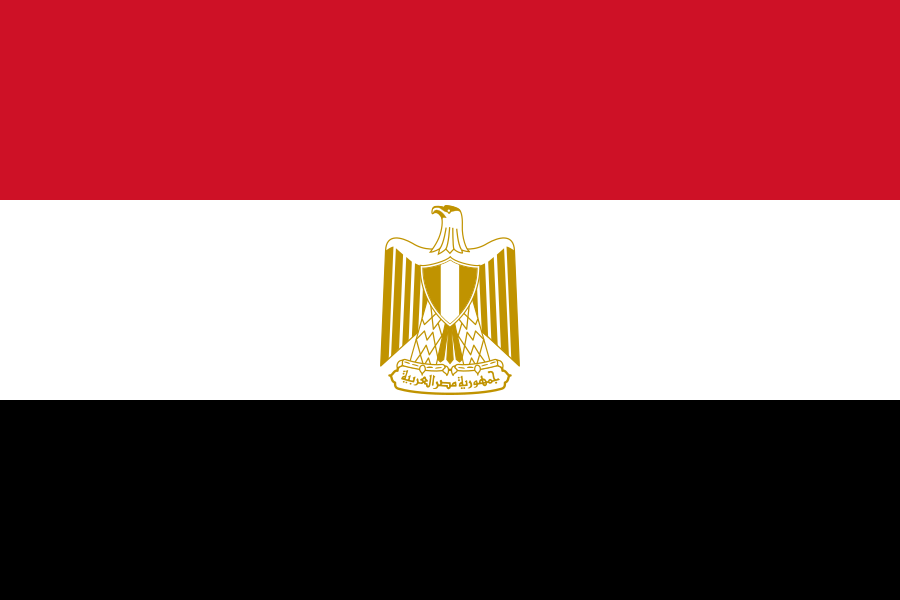
| National colors | red, white, blackCIA World Factbook [2025] · 2026 archive |
| Citizenship rules | citizenship by birth: no; citizenship by descent only: if the father was born in Egypt; dual citizenship recognized: only with prior permission from the government; residency requirement for naturalization: 10 yearsCIA World Factbook [2025] · 2026 archive |
the English name Egypt derives from the ancient Greek name for the country, "Aguptos," and the ancient Roman name, "Aegyptus," with the Greek form coming from the words aia gupos , or "land of the vulture;" the Arabic name for the country, Misr, can be traced to the Assyrian word misir , meaning "fort"
description: three equal horizontal bands of red (top), white, and black; centered in the white band is the national emblem, a gold Eagle of Saladin; it faces the left side, with a shield on its chest, above a scroll with the country's name in Arabic meaning: the band colors derive from the Arab Liberation flag and represent oppression (black) overcome through bloody struggle (red), to be replaced by a bright future (white)
Source: CIA World Factbook (Historical Archive — final edition) · CC0 · Edition 2026-05