| Indicator | Value |
|---|---|
| ISO 3166 alpha-2 | SVISO 3166 [2024] |
| ISO 3166 alpha-3 | SLVISO 3166 [2024] |
| Capital | San SalvadorGeoNames [2024] |
| Continent | North AmericaGeoNames [2024] |
| Common name | El SalvadorCIA World Factbook [2025] · 2026 archive |
| Official name | Republic of El SalvadorCIA World Factbook [2025] · 2026 archive |
| Local name | El SalvadorCIA World Factbook [2025] · 2026 archive |
| Etymology | means "the Savior" in Spanish and is a shortened form of "the Divine Savior of the World" (el Divino Salvador del Mundo), referring to Jesus Christ; 16th-century Spanish colonists gave the name "San Salvador" to the fort located where the country's capital of San Salvador now stands, and the name was later used for the city and the surrounding region; the country was officially named El Salvador in 1824CIA World Factbook [2025] · 2026 archive |
| Government type | Presidential republicCIA World Factbook [2025] · 2026 archive |
| Independence | 15 September 1821 (from Spain)CIA World Factbook [2025] · 2026 archive |
| National holiday | Independence Day, 15 September (1821)CIA World Factbook [2025] · 2026 archive |
| Head of state | Nayib Armando BUKELE Ortez (Pres.)CIA World Leaders [2025] |
| Currency code (ISO 4217) | SVCISO 4217 Currency Codes [2026] |
| Currency | El Salvador ColonISO 4217 Currency Codes [2026] |
| Administrative subdivisions | 14ISO 3166-2 Subdivisions [2026] |
| Subdivision names | Ahuachapán / Cabañas / Chalatenango / Cuscatlán / La Libertad / La Paz / La Unión / Morazán / San Miguel / San Salvador / San Vicente / Santa Ana / Sonsonate / UsulutánISO 3166-2 Subdivisions [2026] |
| Historical overview | "Research completed November 1988." Supercedes the 1971 ed. of Area handbook for El Salvador, coauthored by Howard I. Blutstein [et al.]. Includes bibliographical references (p. 269-283) and index. Also available in digital form.LoC FRD Country Studies [2026] |
| National symbols | turquoise-browed motmot (bird)CIA World Factbook [2025] · 2026 archive |
| National anthem | title: "Himno Nacional de El Salvador" (National Anthem of El Salvador); lyrics/music: Juan Jose CANAS/Juan ABERLE; history: officially adopted 1953, in use since 1879; at four minutes and 20 seconds, the anthem is one of the world's longestCIA World Factbook [2025] · 2026 archive |
| National colors | blue, whiteCIA World Factbook [2025] · 2026 archive |
| Citizenship rules | citizenship by birth: yes; citizenship by descent only: yes; dual citizenship recognized: yes; residency requirement for naturalization: 5 yearsCIA World Factbook [2025] · 2026 archive |
means "the Savior" in Spanish and is a shortened form of "the Divine Savior of the World" (el Divino Salvador del Mundo), referring to Jesus Christ; 16th-century Spanish colonists gave the name "San Salvador" to the fort located where the country's capital of San Salvador now stands, and the name was later used for the city and the surrounding region; the country was officially named El Salvador in 1824
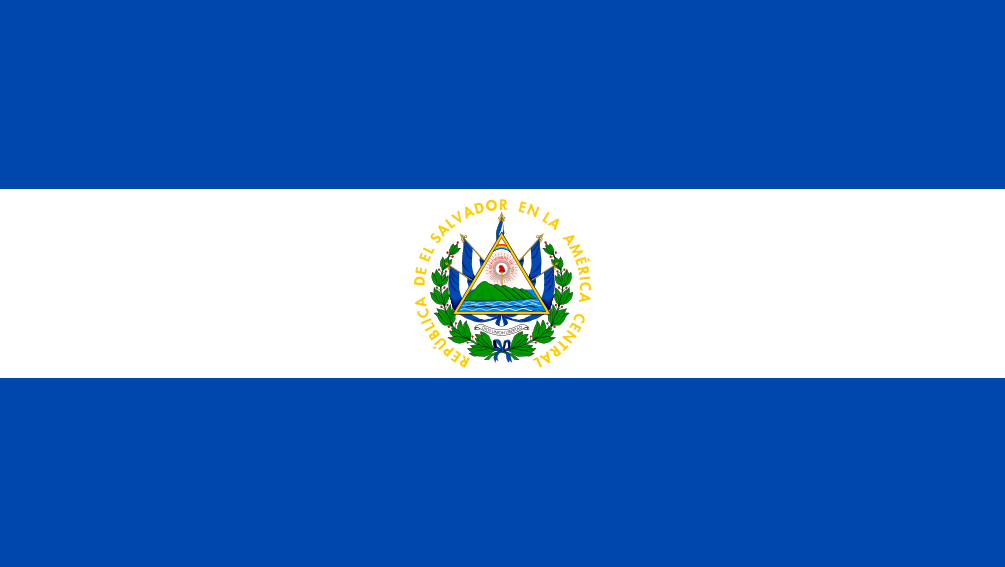
description: three equal horizontal bands of cobalt blue (top), white, and cobalt blue, with the national coat of arms centered in the white band; the coat of arms has a round emblem with the words REPUBLICA DE EL SALVADOR EN LA AMERICA CENTRAL around it meaning: the blue bands stand for the Pacific Ocean and the Caribbean Sea, and the white for the land, as well as peace and prosperity history: the banner is based on the former blue-white-blue flag of the Federal Republic of Central America
Source: CIA World Factbook (Historical Archive — final edition) · CC0 · Edition 2026-05