| Indicator | Value |
|---|---|
| ISO 3166 alpha-2 | MLISO 3166 [2024] |
| ISO 3166 alpha-3 | MLIISO 3166 [2024] |
| Capital | BamakoGeoNames [2024] |
| Continent | AfricaGeoNames [2024] |
| Common name | MaliCIA World Factbook [2025] · 2026 archive |
| Official name | Republic of MaliCIA World Factbook [2025] · 2026 archive |
| Local name | MaliCIA World Factbook [2025] · 2026 archive |
| Etymology | name derives from the Mali Empire of the 13th to 16th centuries A.D.; the Mali name may come from a local ethnic group, the Malinke, whose name is derived from the words ma, meaning "mother," and dink, meaning "child" -- a reference to the matrilinear descent of Malinke familiesCIA World Factbook [2025] · 2026 archive |
| Government type | Semi-presidential republicCIA World Factbook [2025] · 2026 archive |
| Independence | 22 September 1960 (from France)CIA World Factbook [2025] · 2026 archive |
| National holiday | Independence Day, 22 September (1960)CIA World Factbook [2025] · 2026 archive |
| Head of state | Alousseni SANOU (Pres.)CIA World Leaders [2025] |
| Currency code (ISO 4217) | XOFISO 4217 Currency Codes [2026] |
| Currency | CFA Franc BCEAOISO 4217 Currency Codes [2026] |
| Administrative subdivisions | 11ISO 3166-2 Subdivisions [2026] |
| Subdivision names | Bamako / Gao / Kayes / Kidal / Koulikoro / Mopti / Ménaka / Sikasso / Ségou / Taoudénit / TombouctouISO 3166-2 Subdivisions [2026] |
| Historical overview | No authoritative open source found |
| National symbols | Great Mosque of DjenneCIA World Factbook [2025] · 2026 archive |
| National anthem | title: "Le Mali" (Mali); lyrics/music: Seydou Badian KOUYATE/Banzoumana SISSOKO; history: adopted 1962CIA World Factbook [2025] · 2026 archive |
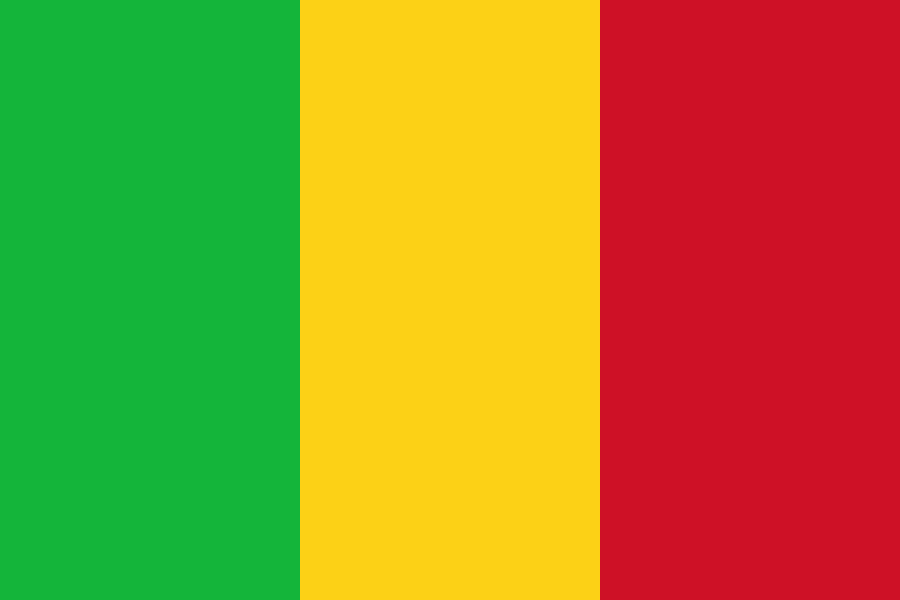
| National colors | green, yellow, redCIA World Factbook [2025] · 2026 archive |
| Citizenship rules | citizenship by birth: no; citizenship by descent only: at least one parent must be a citizen of Mali; dual citizenship recognized: yes; residency requirement for naturalization: 5 yearsCIA World Factbook [2025] · 2026 archive |
name derives from the Mali Empire of the 13th to 16th centuries A.D.; the Mali name may come from a local ethnic group, the Malinke, whose name is derived from the words ma , meaning "mother," and dink , meaning "child" -- a reference to the matrilinear descent of Malinke families
description: three equal vertical bands of green (left side), yellow, and red history: uses the colors of the Pan-African movement
Source: CIA World Factbook (Historical Archive — final edition) · CC0 · Edition 2026-05