| Indicator | Value |
|---|---|
| ISO 3166 alpha-2 | MZISO 3166 [2024] |
| ISO 3166 alpha-3 | MOZISO 3166 [2024] |
| Capital | MaputoGeoNames [2024] |
| Continent | AfricaGeoNames [2024] |
| Common name | MozambiqueCIA World Factbook [2025] · 2026 archive |
| Official name | Republic of MozambiqueCIA World Factbook [2025] · 2026 archive |
| Local name | MocambiqueCIA World Factbook [2025] · 2026 archive |
| Etymology | named for an offshore island; the island was named after Mussa bin BIQUE (or Mussa Ibn MALIK), an influential Arab slave trader who set himself up as sultan on the island in the 15th centuryCIA World Factbook [2025] · 2026 archive |
| Government type | Presidential republicCIA World Factbook [2025] · 2026 archive |
| Independence | 25 June 1975 (from Portugal)CIA World Factbook [2025] · 2026 archive |
| National holiday | Independence Day, 25 June (1975)CIA World Factbook [2025] · 2026 archive |
| Head of state | Daniel Francisco CHAPO (Pres.)CIA World Leaders [2025] |
| Currency code (ISO 4217) | MZNISO 4217 Currency Codes [2026] |
| Currency | Mozambique MeticalISO 4217 Currency Codes [2026] |
| Administrative subdivisions | 11ISO 3166-2 Subdivisions [2026] |
| Subdivision names | Cabo Delgado / Gaza / Inhambane / Manica / Maputo / Nampula / Niassa / Sofala / Tete / ZambéziaISO 3166-2 Subdivisions [2026] |
| Historical overview | No authoritative open source found |
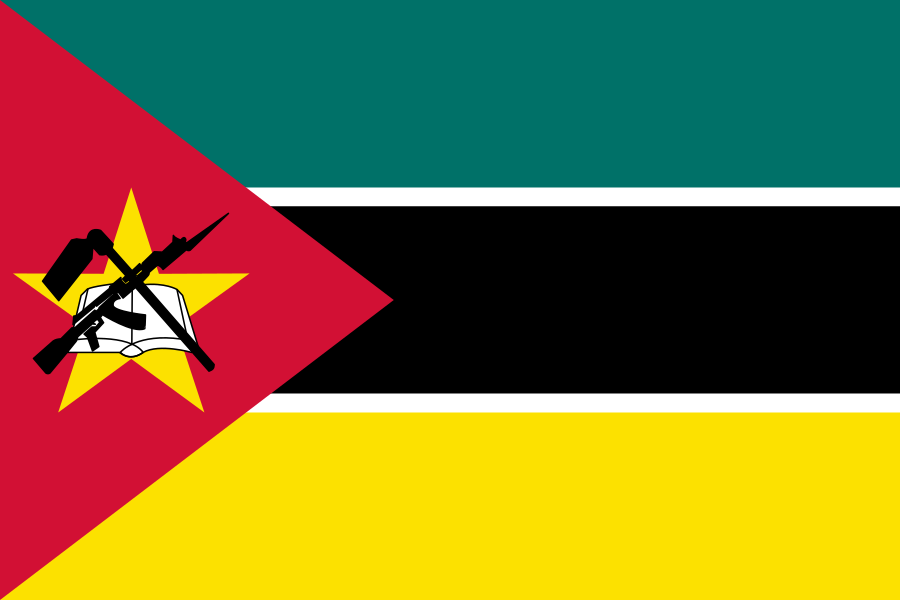
| National symbols | rifle, hoe, and bookCIA World Factbook [2025] · 2026 archive |
| National anthem | title: “Pátria Amada” (Lovely Fatherland); lyrics/music: Salomão J. MANHICA/unkown; history: adopted 2002; the new anthem reflects the new multi-party political systemCIA World Factbook [2025] · 2026 archive |
| National colors | green, black, yellow, white, redCIA World Factbook [2025] · 2026 archive |
| Citizenship rules | citizenship by birth: no; citizenship by descent only: at least one parent must be a citizen of Mozambique; dual citizenship recognized: no; residency requirement for naturalization: 5 yearsCIA World Factbook [2025] · 2026 archive |
named for an offshore island; the island was named after Mussa bin BIQUE (or Mussa Ibn MALIK), an influential Arab slave trader who set himself up as sultan on the island in the 15th century
description: three equal horizontal bands of green (top), black, and yellow, with a red isosceles triangle based on the left side; the black band is edged in white; centered in the triangle is a five-pointed yellow star with a crossed black-and-white rifle and hoe, on top of an open white book meaning: green stands for the riches of the land, white for peace, black for the African continent, yellow for the country's minerals, and red for the fight for independence; the rifle stands for defense and vigilance, the hoe for agriculture, the open book for the importance of education, and the star for Marxism and internationalism
Source: CIA World Factbook (Historical Archive — final edition) · CC0 · Edition 2026-05