| Indicator | Value |
|---|---|
| ISO 3166 alpha-2 | STISO 3166 [2024] |
| ISO 3166 alpha-3 | STPISO 3166 [2024] |
| Capital | Sao TomeGeoNames [2024] |
| Continent | AfricaGeoNames [2024] |
| Common name | Sao Tome and PrincipeCIA World Factbook [2025] · 2026 archive |
| Official name | Democratic Republic of Sao Tome and PrincipeCIA World Factbook [2025] · 2026 archive |
| Local name | Sao Tome e PrincipeCIA World Factbook [2025] · 2026 archive |
| Etymology | Sao Tome was named after Saint THOMAS the Apostle by the Portuguese who discovered the island on 21 December 1470 (or 1471), the saint's feast day; Principe is a shortening of the original Portuguese name of "Ilha do Principe" (Isle of the Prince), referring to Prince ALPHONSO of PortugalCIA World Factbook [2025] · 2026 archive |
| Government type | Semi-presidential republicCIA World Factbook [2025] · 2026 archive |
| Independence | 12 July 1975 (from Portugal)CIA World Factbook [2025] · 2026 archive |
| National holiday | Independence Day, 12 July (1975)CIA World Factbook [2025] · 2026 archive |
| Head of state | Carlos Manuel VILA NOVA (Pres.)CIA World Leaders [2025] |
| Currency code (ISO 4217) | STNISO 4217 Currency Codes [2026] |
| Currency | DobraISO 4217 Currency Codes [2026] |
| Administrative subdivisions | 7ISO 3166-2 Subdivisions [2026] |
| Subdivision names | Cantagalo / Caué / Lembá / Lobata / Mé-Zóchi / Príncipe / Água GrandeISO 3166-2 Subdivisions [2026] |
| Historical overview | No authoritative open source found |
| National symbols | palm treeCIA World Factbook [2025] · 2026 archive |
| National anthem | title: "Independencia total" (Total Independence); lyrics/music: Alda Neves DA GRACA do Espirito Santo/Manuel dos Santos Barreto de Sousa e ALMEIDA; history: adopted 1975CIA World Factbook [2025] · 2026 archive |
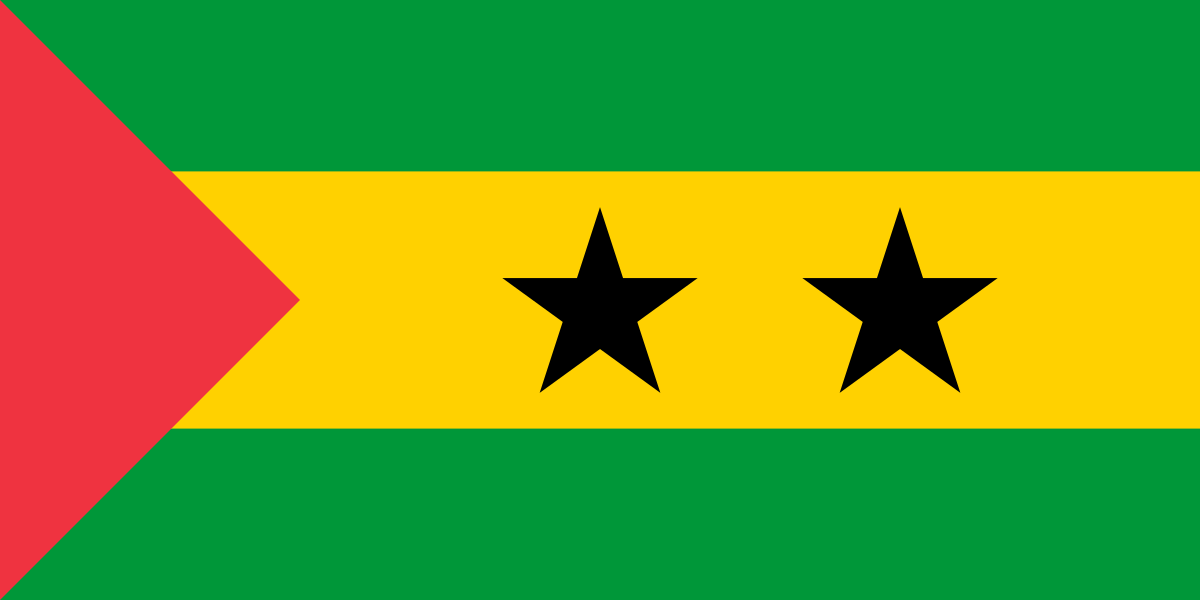
| National colors | green, yellow, red, blackCIA World Factbook [2025] · 2026 archive |
| Citizenship rules | citizenship by birth: no; citizenship by descent only: at least one parent must be a citizen of Sao Tome and Principe; dual citizenship recognized: no; residency requirement for naturalization: 5 yearsCIA World Factbook [2025] · 2026 archive |
Sao Tome was named after Saint THOMAS the Apostle by the Portuguese who discovered the island on 21 December 1470 (or 1471), the saint's feast day; Principe is a shortening of the original Portuguese name of "Ilha do Principe" (Isle of the Prince), referring to Prince ALPHONSO of Portugal
description: three horizontal bands of green (top), yellow (double-width), and green with two five-pointed black stars in the center of the yellow band and a red isosceles triangle based on the left side meaning: green stands for the country's rich vegetation, red for the struggle for independence, and yellow for cocoa, one of the country's main agricultural products; the two stars symbolize the main islands history: uses the colors of the Pan-African movement
Source: CIA World Factbook (Historical Archive — final edition) · CC0 · Edition 2026-05