| Indicator | Value |
|---|---|
| ISO 3166 alpha-2 | AQISO 3166 [2024] |
| ISO 3166 alpha-3 | No authoritative open source found |
| Capital | No authoritative open source found |
| Continent | AntarcticaGeoNames [2024] |
| Common name | AntarcticaCIA World Factbook [2025] · 2026 archive |
| Official name | No authoritative open source found |
| Local name | AntarcticaCIA World Factbook [2025] · 2026 archive |
| Etymology | name derived from two Greek words, anti and arktikos, meaning "opposite to the Arctic" or "opposite to the north"CIA World Factbook [2025] · 2026 archive |
| Government type | the Antarctic Treaty and its follow-on agreements govern the use of Antarctica, ensuring it is used only for peaceful purposes and scientific research; signed in 1959 and in force since 1961, the original Treaty bans military activity, weapons testing, and nuclear waste disposal, while allowing military personnel to assist with research or other peaceful efforts; it promotes international cooperation in science, guarantees the free exchange of research, and freezes territorial claims; the Treaty covers all land and ice south of 60° south latitude, and allows Treaty nations to inspect any station or facilitydecisions are made by consensus at annual meetings, and member countries implement these decisions through their national laws (see “Legal system”); additional agreements have strengthened the Treaty system, including conventions to protect seals (1972) and other marine life (1980), as well as an environmental protocol (1991, took effect in 1998); the protocol bans mining and includes strict rules on environmental impact, waste, pollution, wildlife, and protected areas; as of December 2024, there are 58 member nations: 29 consultative members, including the 7 claimant countries (Argentina, Australia, Chile, France, New Zealand, Norway, and the UK), and 29 non-consultative members; a permanent Antarctic Treaty Secretariat, established in 2004 in Buenos Aires, supports the systemCIA World Factbook [2025] · 2026 archive |
| Independence | No authoritative open source found |
| National holiday | No authoritative open source found |
| Head of state | No authoritative open source found |
| Currency code (ISO 4217) | No authoritative open source found |
| Currency | No authoritative open source found |
| Administrative subdivisions | No authoritative open source found |
| Subdivision names | No authoritative open source found |
| Historical overview | No authoritative open source found |
| National symbols | Not applicable to this country |
| National anthem | Not applicable to this country |
| National colors | Not applicable to this country |
| Citizenship rules | Not applicable to this country |
name derived from two Greek words, anti and arktikos , meaning "opposite to the Arctic" or "opposite to the north"
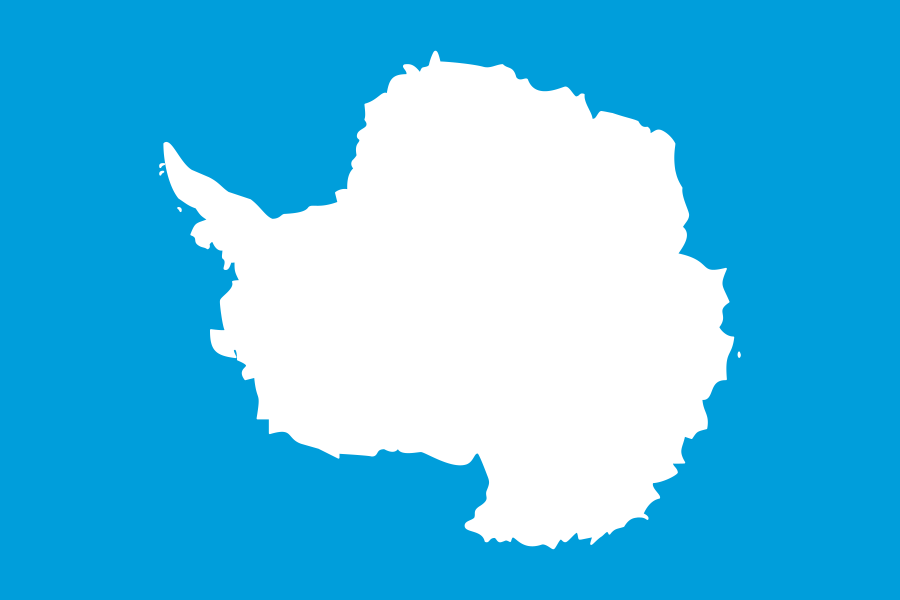
description: two horizontal bands of navy and white, with a stylized white peak at the center; the peak casts a navy shadow in the shape of a compass arrow pointed south meaning: the bands represent the long days and nights at Antarctica's extreme latitude; the compass arrow is an homage to the continent's legacy of exploration; the peak and the arrow together create a diamond, symbolizing the hope that Antarctica will continue to be a center of peace, discovery, and cooperation history: the flag is unofficial; created in 2018, the True South flag has quickly become popular for its simple yet elegant design and has been used by national Antarctic programs, Antarctic nonprofits, and expedition teams
Source: CIA World Factbook (Historical Archive — final edition) · CC0 · Edition 2026-05