| Indicator | Value |
|---|---|
| ISO 3166 alpha-2 | BGISO 3166 [2024] |
| ISO 3166 alpha-3 | BGRISO 3166 [2024] |
| Capital | SofiaGeoNames [2024] |
| Continent | EuropeGeoNames [2024] |
| Common name | BulgariaCIA World Factbook [2025] · 2026 archive |
| Official name | Republic of BulgariaCIA World Factbook [2025] · 2026 archive |
| Local name | BulgariaCIA World Factbook [2025] · 2026 archive |
| Etymology | named after the Bulgar tribes who settled the lower Balkan region in the 7th century A.D.; the tribal name may come from the Turkic word bulga, or "mixed," referring to the blend of Turkic and Slavic ethnicities in the tribesCIA World Factbook [2025] · 2026 archive |
| Government type | Parliamentary republicCIA World Factbook [2025] · 2026 archive |
| Independence | 3 March 1878 (as an autonomous principality within the Ottoman Empire); 22 September 1908 (complete independence from the Ottoman Empire)CIA World Factbook [2025] · 2026 archive |
| National holiday | Liberation Day, 3 March (1878)CIA World Factbook [2025] · 2026 archive |
| Head of state | Rumen RADEV (Pres.)CIA World Leaders [2025] |
| Currency code (ISO 4217) | EURISO 4217 Currency Codes [2026] |
| Currency | EuroISO 4217 Currency Codes [2026] |
| Administrative subdivisions | 28ISO 3166-2 Subdivisions [2026] |
| Subdivision names | Blagoevgrad / Burgas / Dobrich / Gabrovo / Haskovo / Kardzhali / Kyustendil / Lovech / Montana / Pazardzhik / Pernik / Pleven / Plovdiv / Razgrad / Ruse / Shumen / Silistra / Sliven / Smolyan / Sofia / Sofia (stolitsa) / Stara Zagora / Targovishte / Varna / Veliko Tarnovo / Vidin / Vratsa / YambolISO 3166-2 Subdivisions [2026] |
| Historical overview | "Research completed June 1992." Supersedes the 1974 ed. of Area handbook for Bulgaria, coauthored by Eugene K. Keefe [et al.]. Includes bibliographical references (p. 287-295) and index. Also available in digital form.LoC FRD Country Studies [2026] |
| National symbols | lionCIA World Factbook [2025] · 2026 archive |
| National anthem | title: “Mila Rodino” (Dear Homeland); lyrics/music: Tsvetan RADOSLAVOV; history: adopted 1964; composed in 1885 by a student en route to fight in the Serbo-Bulgarian WarCIA World Factbook [2025] · 2026 archive |
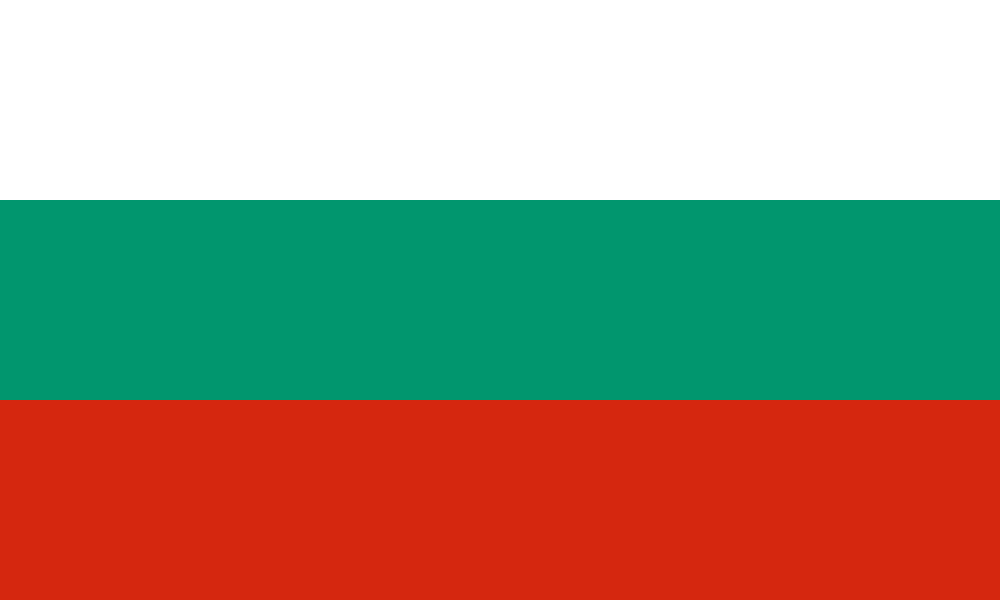
| National colors | white, green, redCIA World Factbook [2025] · 2026 archive |
| Citizenship rules | citizenship by birth: no; citizenship by descent only: at least one parent must be a citizen of Bulgaria; dual citizenship recognized: yes; residency requirement for naturalization: 5 yearsCIA World Factbook [2025] · 2026 archive |
named after the Bulgar tribes who settled the lower Balkan region in the 7th century A.D.; the tribal name may come from the Turkic word bulga , or "mixed," referring to the blend of Turkic and Slavic ethnicities in the tribes
description: three equal horizontal bands of white (top), green, and red meaning: white stands for peace, love, and freedom; green for the country's agricultural wealth; red for the independence struggle and military courage history: originally adopted in 1879 as a modified version of the Russian tricolor flag, using green instead of blue; the communist coat of arms was added to the flag in various forms between 1948 and 1990, when it was removed after the communist government collapsed
Source: CIA World Factbook (Historical Archive — final edition) · CC0 · Edition 2026-05