| Indicator | Value |
|---|---|
| ISO 3166 alpha-2 | CNISO 3166 [2024] |
| ISO 3166 alpha-3 | CHNISO 3166 [2024] |
| Capital | BeijingGeoNames [2024] |
| Continent | AsiaGeoNames [2024] |
| Common name | ChinaCIA World Factbook [2025] · 2026 archive |
| Official name | People's Republic of ChinaCIA World Factbook [2025] · 2026 archive |
| Local name | ZhongguoCIA World Factbook [2025] · 2026 archive |
| Etymology | English name could be derived from the Qin (Chin, Ts'in) rulers in the 3rd century B.C., or from the province of Shaanxi (Shensi) with its capital of Xi'an (Sian); the Chinese name Zhongguo translates as "Central Nation" or "Middle Country"CIA World Factbook [2025] · 2026 archive |
| Government type | Communist party-led stateCIA World Factbook [2025] · 2026 archive |
| Independence | 1 October 1949 (People's Republic of China established); notable earlier dates: 221 B.C. (unification under the Qin Dynasty); 1 January 1912 (Qing Dynasty replaced by the Republic of China)CIA World Factbook [2025] · 2026 archive |
| National holiday | National Day (anniversary of the founding of the People's Republic of China), 1 October (1949)CIA World Factbook [2025] · 2026 archive |
| Head of state | XI Jinping (Pres.)CIA World Leaders [2025] |
| Currency code (ISO 4217) | CNYISO 4217 Currency Codes [2026] |
| Currency | Yuan RenminbiISO 4217 Currency Codes [2026] |
| Administrative subdivisions | 34ISO 3166-2 Subdivisions [2026] |
| Subdivision names | Anhui Sheng / Beijing Shi / Chongqing Shi / Fujian Sheng / Gansu Sheng / Guangdong Sheng / Guangxi Zhuangzu Zizhiqu / Guizhou Sheng / Hainan Sheng / Hebei Sheng / Heilongjiang Sheng / Henan Sheng / Hong Kong SAR / Hubei Sheng / Hunan Sheng / Jiangsu Sheng / Jiangxi Sheng / Jilin Sheng / Liaoning Sheng / Macao SAR / Nei Mongol Zizhiqu / Ningxia Huizu Zizhiqu / Qinghai Sheng / Shaanxi Sheng / Shandong Sheng / Shanghai Shi / Shanxi Sheng / Sichuan Sheng / Taiwan Sheng / Tianjin Shi / Xinjiang Uygur Zizhiqu / Xizang Zizhiqu / Yunnan Sheng / Zhejiang ShengISO 3166-2 Subdivisions [2026] |
| Historical overview | "Research completed July 1987." Supersedes the 1981 ed. of China : a country study, prepared by Foreign Area Studies, the American University and edited by Frederica M. Bunge and Rinn-Sup Shinn. Includes bibliographical references (p. 637-697) and index. Also available in digital form.LoC FRD Country Studies [2026] |
| National symbols | dragon, giant pandaCIA World Factbook [2025] · 2026 archive |
| National anthem | title: "Yiyongjun Jinxingqu" (The March of the Volunteers); lyrics/music: TIAN Han/NIE Er; history: adopted 1982; the anthem, which was banned during the Cultural Revolution, is more commonly known as "Zhongguo Guoge" (Chinese National Song)CIA World Factbook [2025] · 2026 archive |
| National colors | red, yellowCIA World Factbook [2025] · 2026 archive |
| Citizenship rules | citizenship by birth: no; citizenship by descent only: least one parent must be a citizen of China; dual citizenship recognized: no; residency requirement for naturalization: while naturalization is theoretically possible, in practical terms it is extremely difficult; residency is required but not specifiedCIA World Factbook [2025] · 2026 archive |
English name could be derived from the Qin (Chin, Ts'in) rulers in the 3rd century B.C., or from the province of Shaanxi (Shensi) with its capital of Xi'an (Sian); the Chinese name Zhongguo translates as "Central Nation" or "Middle Country"
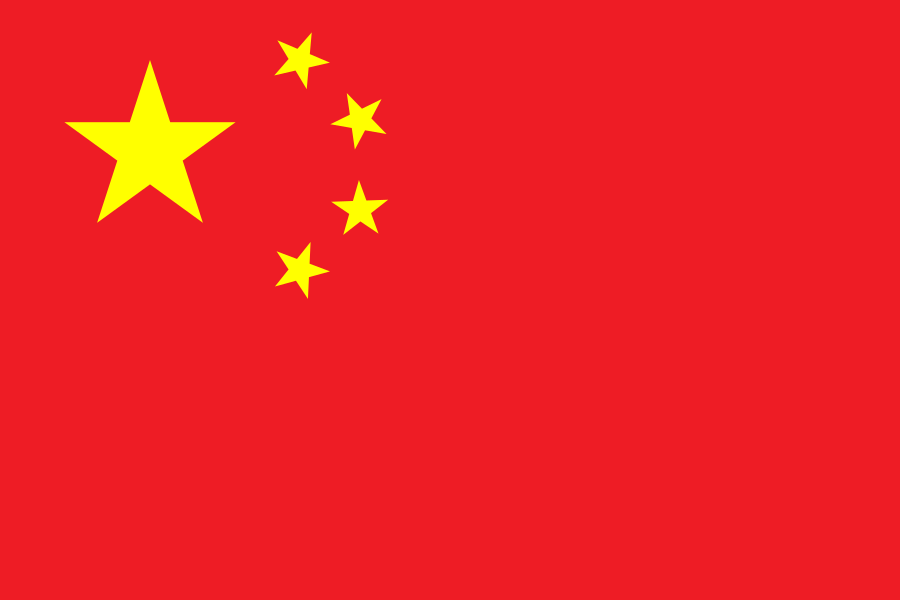
description: red with a large five-pointed yellow star and four smaller ones in the upper-left corner; the small stars are arranged in a vertical arc around the large one meaning: red represents revolution; the stars symbolize the four social classes -- the working class, the peasantry, the urban petty bourgeoisie, and the national bourgeoisie (capitalists) -- united under the Communist Party of China
Source: CIA World Factbook (Historical Archive — final edition) · CC0 · Edition 2026-05