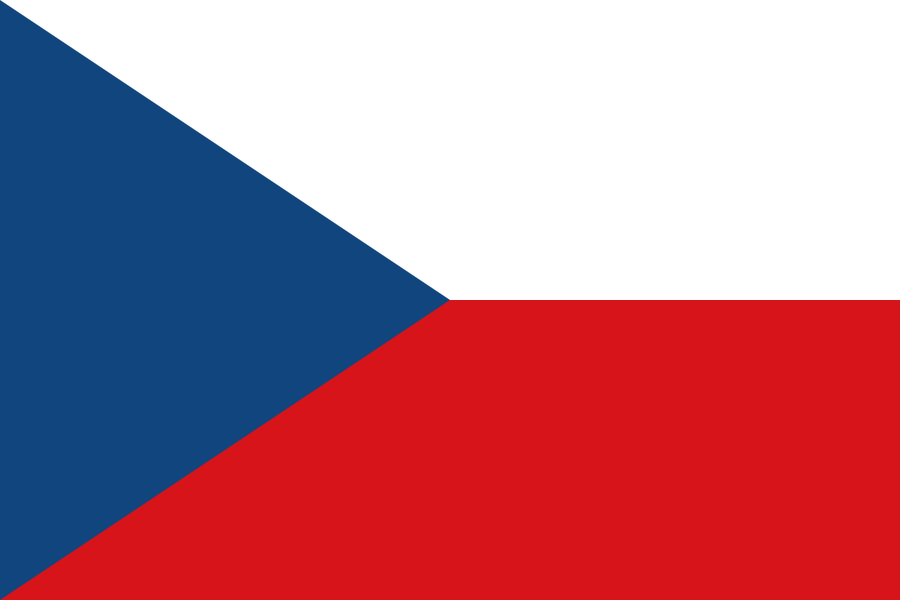
| Indicator | Value |
|---|---|
| ISO 3166 alpha-2 | CZISO 3166 [2024] |
| ISO 3166 alpha-3 | CZEISO 3166 [2024] |
| Capital | PragueGeoNames [2024] |
| Continent | EuropeGeoNames [2024] |
| Common name | CzechiaCIA World Factbook [2025] · 2026 archive |
| Official name | Czech RepublicCIA World Factbook [2025] · 2026 archive |
| Local name | CeskoCIA World Factbook [2025] · 2026 archive |
| Etymology | name derives from the Czechs, a West Slavic tribe who rose to prominence in the late 9th century A.D.; the tribal name is said to come from an ancestral chiefCIA World Factbook [2025] · 2026 archive |
| Government type | Parliamentary republicCIA World Factbook [2025] · 2026 archive |
| Independence | 1 January 1993 (Czechoslovakia split into the Czech Republic and Slovakia); note: although 1 January is the day the Czech Republic came into being, the Czechs commemorate 28 October 1918, the day the former Czechoslovakia declared its independence from the Austro-Hungarian Empire, as their independence dayCIA World Factbook [2025] · 2026 archive |
| National holiday | Czechoslovak Founding Day, 28 October (1918)CIA World Factbook [2025] · 2026 archive |
| Head of state | Petr PAVEL (Pres.)CIA World Leaders [2025] |
| Currency code (ISO 4217) | CZKISO 4217 Currency Codes [2026] |
| Currency | Czech KorunaISO 4217 Currency Codes [2026] |
| Administrative subdivisions | 14ISO 3166-2 Subdivisions [2026] |
| Subdivision names | Jihomoravský kraj / Jihočeský kraj / Karlovarský kraj / Kraj Vysočina / Královéhradecký kraj / Liberecký kraj / Moravskoslezský kraj / Olomoucký kraj / Pardubický kraj / Plzeňský kraj / Praha, Hlavní město / Středočeský kraj / Zlínský kraj / Ústecký krajISO 3166-2 Subdivisions [2026] |
| Historical overview | No authoritative open source found |
| National symbols | silver (or white) double-tailed rampant lionCIA World Factbook [2025] · 2026 archive |
| National anthem | title: "Kde domov muj?" (Where is My Home?); lyrics/music: Josef Kajetan TYL/Frantisek Jan SKROUP; history: adopted 1993; the anthem was originally written as incidental music for the play "Fidlovacka" (1834), but it soon became popular as an unofficial anthem of the Czech nation; its first verse served as the official Czechoslovak anthem beginning in 1918, and the second verse (Slovak) was dropped after Czechoslovakia was dissolved in 1993CIA World Factbook [2025] · 2026 archive |
| National colors | white, red, blueCIA World Factbook [2025] · 2026 archive |
| Citizenship rules | citizenship by birth: no; citizenship by descent only: at least one parent must be a citizen of Czechia; dual citizenship recognized: no; residency requirement for naturalization: 5 yearsCIA World Factbook [2025] · 2026 archive |
name derives from the Czechs, a West Slavic tribe who rose to prominence in the late 9th century A.D.; the tribal name is said to come from an ancestral chief
description: two equal horizontal bands of white (top) and red with a blue isosceles triangle based on the left side
Source: CIA World Factbook (Historical Archive — final edition) · CC0 · Edition 2026-05