| Indicator | Value |
|---|---|
| ISO 3166 alpha-2 | JPISO 3166 [2024] |
| ISO 3166 alpha-3 | JPNISO 3166 [2024] |
| Capital | TokyoGeoNames [2024] |
| Continent | AsiaGeoNames [2024] |
| Common name | JapanCIA World Factbook [2025] · 2026 archive |
| Official name | No authoritative open source found |
| Local name | Nihon/NipponCIA World Factbook [2025] · 2026 archive |
| Etymology | the English word for Japan comes from the Chinese name for the country, Cipangu; both Nihon and Nippon come from the Japanese words nichi, or "sun," and hon, or "origin," which is frequently translated as "Land of the Rising Sun"CIA World Factbook [2025] · 2026 archive |
| Government type | Parliamentary constitutional monarchyCIA World Factbook [2025] · 2026 archive |
| Independence | 3 May 1947 (current constitution adopted as amendment to Meiji Constitution); notable earlier dates: 11 February 660 B.C. (mythological date of Emperor JIMMU founding the nation); 29 November 1890 (Meiji Constitution provides for constitutional monarchy)CIA World Factbook [2025] · 2026 archive |
| National holiday | Birthday of Emperor NARUHITO, 23 February (1960); note: celebrates the birthday of the current emperorCIA World Factbook [2025] · 2026 archive |
| Head of state | NARUHITO (Emperor)CIA World Leaders [2025] |
| Currency code (ISO 4217) | JPYISO 4217 Currency Codes [2026] |
| Currency | YenISO 4217 Currency Codes [2026] |
| Administrative subdivisions | 47ISO 3166-2 Subdivisions [2026] |
| Subdivision names | Aichi / Akita / Aomori / Chiba / Ehime / Fukui / Fukuoka / Fukushima / Gifu / Gunma / Hiroshima / Hokkaido / Hyogo / Ibaraki / Ishikawa / Iwate / Kagawa / Kagoshima / Kanagawa / Kochi / Kumamoto / Kyoto / Mie / Miyagi / Miyazaki / Nagano / Nagasaki / Nara / Niigata / Oita / Okayama / Okinawa / Osaka / Saga / Saitama / Shiga / Shimane / Shizuoka / Tochigi / Tokushima / Tokyo / Tottori / Toyama / Wakayama / Yamagata / Yamaguchi / YamanashiISO 3166-2 Subdivisions [2026] |
| Historical overview | "Research completed September 1990." Supersedes the 1983 ed. of Japan : a country study, edited by Frederica M. Bunge. Includes bibliographical references (p. 511-571) and index. Also available in digital form.LoC FRD Country Studies [2026] |
| National symbols | red sun disc, chrysanthemumCIA World Factbook [2025] · 2026 archive |
| National anthem | title: "Kimigayo" (“His Majesty’s Reign); lyrics/music: unknown/Hiromori HAYASHI; history: adopted 1999; unofficial national anthem since 1883; oldest anthem lyrics in the world, dating to the 10th century or earlier; some oppose the anthem because of its association with militarism and worship of the emperorCIA World Factbook [2025] · 2026 archive |
| National colors | red, whiteCIA World Factbook [2025] · 2026 archive |
| Citizenship rules | citizenship by birth: no; citizenship by descent only: at least one parent must be a citizen of Japan; dual citizenship recognized: no; residency requirement for naturalization: 5 yearsCIA World Factbook [2025] · 2026 archive |
the English word for Japan comes from the Chinese name for the country, Cipangu; both Nihon and Nippon come from the Japanese words nichi , or "sun," and hon , or "origin," which is frequently translated as "Land of the Rising Sun"
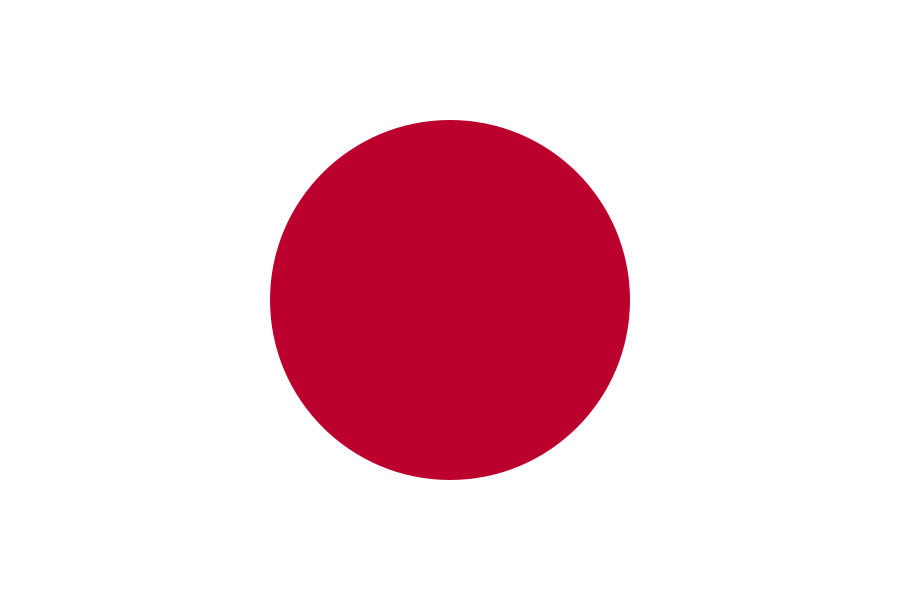
description: white with a large red disk that symbolizes the sun without rays, in the center history: the current flag was adopted in 1854, but a sun flag has been in use in Japan since at least 1184; the sun has long been a national symbol: according to tradition, the sun goddess Amaterasu founded the country in the 7th century B.C.
Source: CIA World Factbook (Historical Archive — final edition) · CC0 · Edition 2026-05