| Indicator | Value |
|---|---|
| ISO 3166 alpha-2 | LYISO 3166 [2024] |
| ISO 3166 alpha-3 | LBYISO 3166 [2024] |
| Capital | TripoliGeoNames [2024] |
| Continent | AfricaGeoNames [2024] |
| Common name | LibyaCIA World Factbook [2025] · 2026 archive |
| Official name | State of LibyaCIA World Factbook [2025] · 2026 archive |
| Local name | LibiyaCIA World Factbook [2025] · 2026 archive |
| Etymology | the name probably derives from the Libu, a North African tribe first mentioned in texts from the 13th century B.C.; the ancient Greeks and Romans used the name for the entire North African coast west of EgyptCIA World Factbook [2025] · 2026 archive |
| Government type | In transitionCIA World Factbook [2025] · 2026 archive |
| Independence | 24 December 1951 (from UN trusteeship)CIA World Factbook [2025] · 2026 archive |
| National holiday | Liberation Day, 23 October (2011)CIA World Factbook [2025] · 2026 archive |
| Head of state | Muhammad al-MANFI (Pres., Presidency Council)CIA World Leaders [2025] |
| Currency code (ISO 4217) | LYDISO 4217 Currency Codes [2026] |
| Currency | Libyan DinarISO 4217 Currency Codes [2026] |
| Administrative subdivisions | 22ISO 3166-2 Subdivisions [2026] |
| Subdivision names | Al Buţnān / Al Jabal al Akhḑar / Al Jabal al Gharbī / Al Jafārah / Al Jufrah / Al Kufrah / Al Marj / Al Marqab / Al Wāḩāt / An Nuqāţ al Khams / Az Zāwiyah / Banghāzī / Darnah / Ghāt / Mişrātah / Murzuq / Nālūt / Sabhā / Surt / Wādī al Ḩayāt / Wādī ash Shāţi’ / ŢarābulusISO 3166-2 Subdivisions [2026] |
| Historical overview | "Research completed December 1987." Supercedes the 1979 ed. of Libya : a country study, edited by Harold D. Nelson. Includes bibliographic references (p. 305-324) and index. Also available in digital form.LoC FRD Country Studies [2026] |
| National symbols | star and crescent, hawkCIA World Factbook [2025] · 2026 archive |
| National anthem | title: "Libya, Libya, Libya"; lyrics/music: Al Bashir AL AREBI/Mohamad Abdel WAHAB; history: adopted 1951, but replaced in 1969 when QADHAFI came to power; readopted 2011 with some modification to the lyrics; also known as "Ya Beladi" (O My Country)CIA World Factbook [2025] · 2026 archive |
| National colors | red, black, greenCIA World Factbook [2025] · 2026 archive |
| Citizenship rules | citizenship by birth: no; citizenship by descent only: at least one parent or grandparent must be a citizen of Libya; dual citizenship recognized: no; residency requirement for naturalization: varies from 3 to 5 yearsCIA World Factbook [2025] · 2026 archive |
the name probably derives from the Libu, a North African tribe first mentioned in texts from the 13th century B.C.; the ancient Greeks and Romans used the name for the entire North African coast west of Egypt
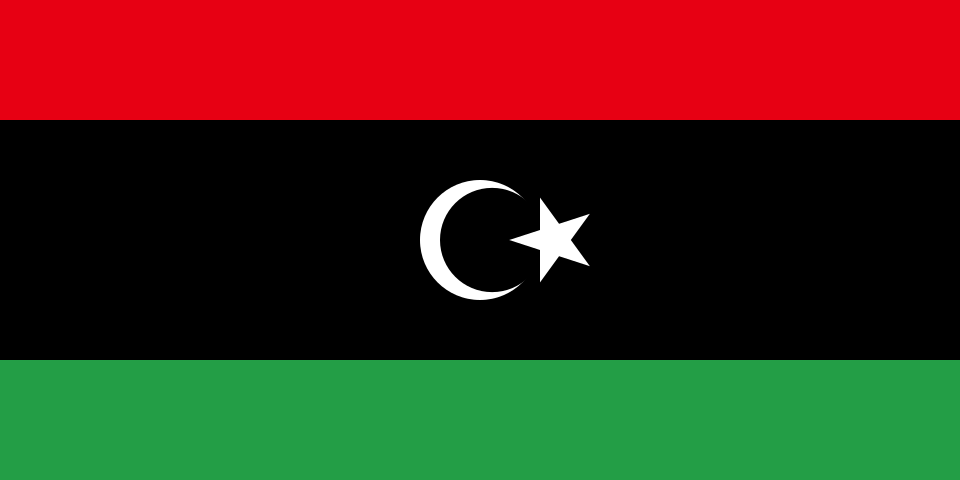
description: three horizontal bands of red (top), black (double-width), and green, with a white crescent and star centered on the black stripe meaning: the colors represent the three major regions of the country: red stands for Fezzan, black for Cyrenaica, and green for Tripolitania; the crescent and star represent Islam history: the National Transitional Council reintroduced this flag design from the former Kingdom of Libya (1951-69) in 2011 to replace the all-green banner of the QADHAFI regime
Source: CIA World Factbook (Historical Archive — final edition) · CC0 · Edition 2026-05