| Indicator | Value |
|---|---|
| ISO 3166 alpha-2 | MHISO 3166 [2024] |
| ISO 3166 alpha-3 | MHLISO 3166 [2024] |
| Capital | MajuroGeoNames [2024] |
| Continent | OceaniaGeoNames [2024] |
| Common name | Marshall IslandsCIA World Factbook [2025] · 2026 archive |
| Official name | Republic of the Marshall IslandsCIA World Factbook [2025] · 2026 archive |
| Local name | Marshall IslandsCIA World Factbook [2025] · 2026 archive |
| Etymology | named after British Captain John MARSHALL, who charted many of the islands in 1788CIA World Factbook [2025] · 2026 archive |
| Government type | mixed presidential-parliamentary system in free association with the USCIA World Factbook [2025] · 2026 archive |
| Independence | 21 October 1986 (from the US-administered UN trusteeship)CIA World Factbook [2025] · 2026 archive |
| National holiday | Constitution Day, 1 May (1979)CIA World Factbook [2025] · 2026 archive |
| Head of state | Hilda Cathy HEINE (Pres.)CIA World Leaders [2025] |
| Currency code (ISO 4217) | USDISO 4217 Currency Codes [2026] |
| Currency | US DollarISO 4217 Currency Codes [2026] |
| Administrative subdivisions | 2ISO 3166-2 Subdivisions [2026] |
| Subdivision names | Ralik chain / Ratak chainISO 3166-2 Subdivisions [2026] |
| Historical overview | No authoritative open source found |
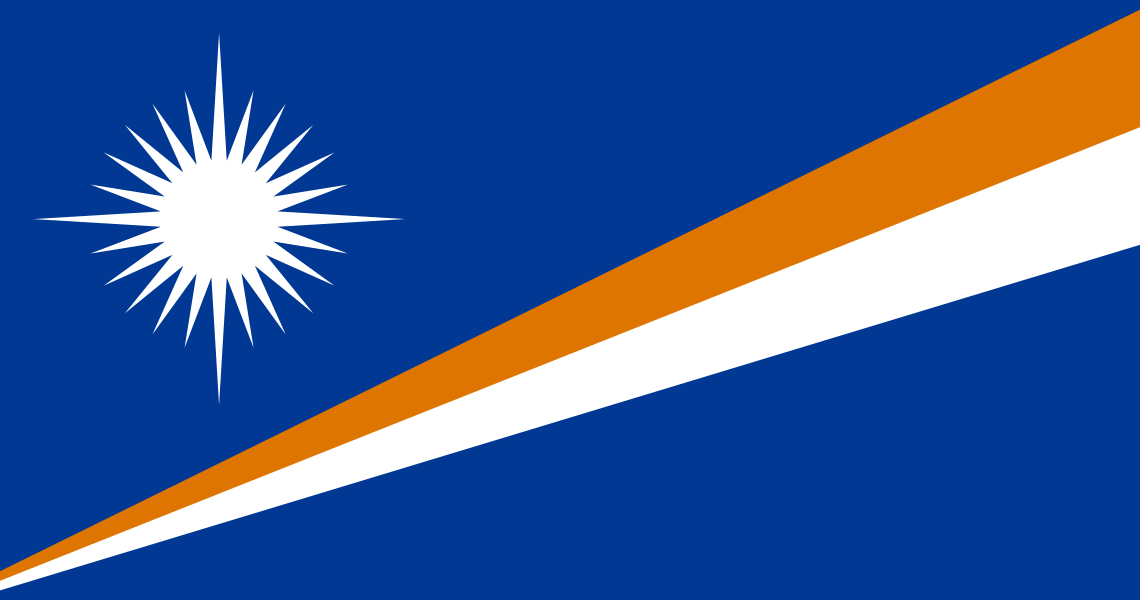
| National symbols | a 24-rayed starCIA World Factbook [2025] · 2026 archive |
| National anthem | title: "Forever Marshall Islands"; lyrics/music: Amata KABUA; history: adopted 1981; words and music written by the first president of the Marshall IslandsCIA World Factbook [2025] · 2026 archive |
| National colors | blue, white, orangeCIA World Factbook [2025] · 2026 archive |
| Citizenship rules | citizenship by birth: no; citizenship by descent only: at least one parent must be a citizen of the Marshall Islands; dual citizenship recognized: no; residency requirement for naturalization: 5 yearsCIA World Factbook [2025] · 2026 archive |
named after British Captain John MARSHALL, who charted many of the islands in 1788
description: blue with an orange stripe and a white stripe radiating from the lower-left corner to the upper-right corner; a white star with four large rays and 20 small rays appears on the left side above the two stripes meaning: blue stands for the Pacific Ocean, orange for the Ralik Chain (or sunset and courage), and white for the Ratak Chain (or sunrise and peace); the star symbolizes the Christian cross, with a small ray for each electoral district and a larger ray for the principal cultural centers of Majuro, Jaluit, Wotje, and Ebeye; the diagonal stripes can also be interpreted as representing the equator, with the star showing the archipelago's position
Source: CIA World Factbook (Historical Archive — final edition) · CC0 · Edition 2026-05