| Indicator | Value |
|---|---|
| ISO 3166 alpha-2 | CUISO 3166 [2024] |
| ISO 3166 alpha-3 | CUBISO 3166 [2024] |
| Capital | HavanaGeoNames [2024] |
| Continent | North AmericaGeoNames [2024] |
| Common name | CubaCIA World Factbook [2025] · 2026 archive |
| Official name | Republic of CubaCIA World Factbook [2025] · 2026 archive |
| Local name | CubaCIA World Factbook [2025] · 2026 archive |
| Etymology | the origin of the name is disputed; it could be derived from a local Taino word, either cubao, meaning "where fertile land is abundant," or coabana, meaning "great place"CIA World Factbook [2025] · 2026 archive |
| Government type | Communist stateCIA World Factbook [2025] · 2026 archive |
| Independence | 20 May 1902 (from US administration); 10 December 1898 (from Spain); not acknowledged by the Cuban Government as days of independenceCIA World Factbook [2025] · 2026 archive |
| National holiday | Triumph of the Revolution (Liberation Day), 1 January (1959)CIA World Factbook [2025] · 2026 archive |
| Head of state | Miguel DIAZ-CANEL Bermudez (Pres. of the Republic)CIA World Leaders [2025] |
| Currency code (ISO 4217) | CUPISO 4217 Currency Codes [2026] |
| Currency | Cuban PesoISO 4217 Currency Codes [2026] |
| Administrative subdivisions | 16ISO 3166-2 Subdivisions [2026] |
| Subdivision names | Artemisa / Camagüey / Ciego de Ávila / Cienfuegos / Granma / Guantánamo / Holguín / Isla de la Juventud / La Habana / Las Tunas / Matanzas / Mayabeque / Pinar del Río / Sancti Spíritus / Santiago de Cuba / Villa ClaraISO 3166-2 Subdivisions [2026] |
| Historical overview | "Research completed April 2001." Supercedes the 1987 ed. of Cuba : a country study, edited by James D. Rudolph. Includes bibliographical references (p. 391-424) and index. Also available in digital form.LoC FRD Country Studies [2026] |
| National symbols | royal palmCIA World Factbook [2025] · 2026 archive |
| National anthem | title: "La Bayamesa" (The Bayamo Song); lyrics/music: Pedro FIGUEREDO; history: adopted 1940; Pedro FIGUEREDO first performed it in 1868 during the Ten Years War against the Spanish; a leading figure in the uprising, FIGUEREDO was captured in 1870 and executed by a firing squad; just before being shot, he is said to have shouted, "Morir por la Patria es vivir" (To die for the country is to live), a line from the anthemCIA World Factbook [2025] · 2026 archive |
| National colors | red, white, blueCIA World Factbook [2025] · 2026 archive |
| Citizenship rules | citizenship by birth: yes; citizenship by descent only: yes; dual citizenship recognized: no; residency requirement for naturalization: unknownCIA World Factbook [2025] · 2026 archive |
the origin of the name is disputed; it could be derived from a local Taino word, either cubao , meaning "where fertile land is abundant," or coabana, meaning "great place"
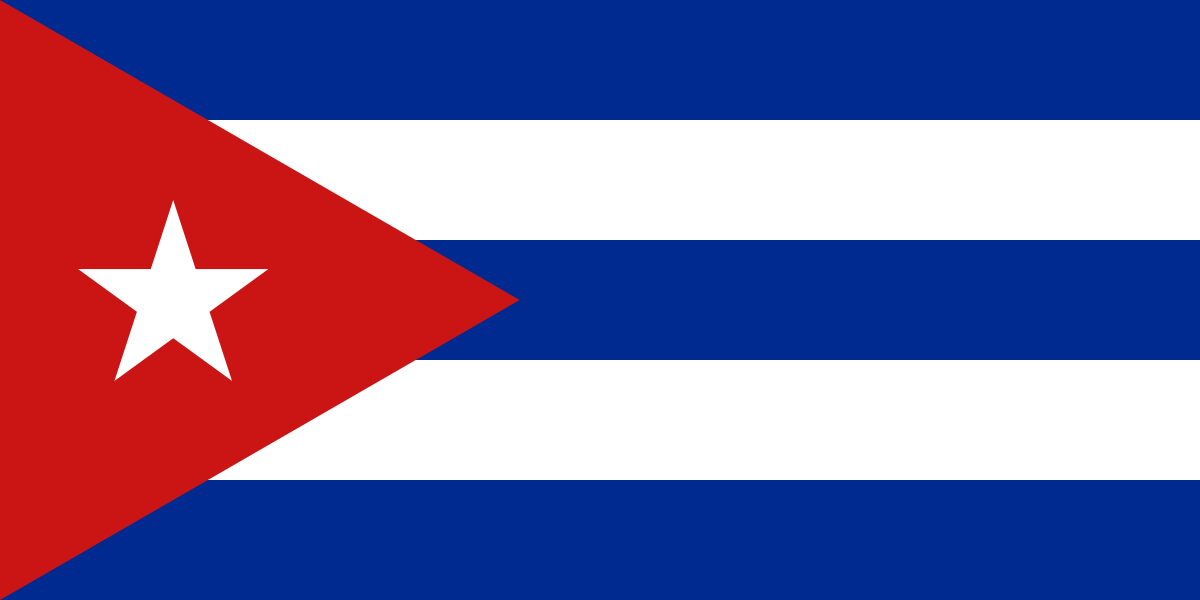
description: five equal horizontal bands of blue (top, center, and bottom) alternating with white; a red equilateral triangle based on the left side has a five-pointed white star in the center meaning: the blue bands stand for the islands' three former departments: Central, Occidental, and Oriental; the white bands for the purity of the independence ideal; the triangle for liberty, equality, and fraternity; the red color for the blood shed in the independence struggle; the white star, called "La Estrella Solitaria" (the Lone Star), lights the way to freedom and was inspired by the state flag of Texas
Source: CIA World Factbook (Historical Archive — final edition) · CC0 · Edition 2026-05