| Indicator | Value |
|---|---|
| ISO 3166 alpha-2 | DEISO 3166 [2024] |
| ISO 3166 alpha-3 | DEUISO 3166 [2024] |
| Capital | BerlinGeoNames [2024] |
| Continent | EuropeGeoNames [2024] |
| Common name | GermanyCIA World Factbook [2025] · 2026 archive |
| Official name | Federal Republic of GermanyCIA World Factbook [2025] · 2026 archive |
| Local name | DeutschlandCIA World Factbook [2025] · 2026 archive |
| Etymology | the origin of the name is unclear; it may come from Celtic words meaning "neighboring people," or it may derive from Germanic words meaning either "spear man" or "head man;" the native designation "Deutsch" comes from the Old High German "diutisc" meaning "national"CIA World Factbook [2025] · 2026 archive |
| Government type | Federal parliamentary republicCIA World Factbook [2025] · 2026 archive |
| Independence | 18 January 1871 (establishment of the German Empire); divided into four zones of occupation (UK, US, USSR, and France) in 1945 after World War II; Federal Republic of Germany (FRG or West Germany) proclaimed on 23 May 1949 and included the former UK, US, and French zones; German Democratic Republic (GDR or East Germany) proclaimed on 7 October 1949 and included the former USSR zone; West Germany and East Germany unified on 3 October 1990, with all four powers formally relinquishing rights on 15 March 1991; notable earlier dates: 10 August 843 (Eastern Francia established from the division of the Carolingian Empire); 2 February 962 (crowning of OTTO I, recognized as the first Holy Roman Emperor)CIA World Factbook [2025] · 2026 archive |
| National holiday | German Unity Day, 3 October (1990)CIA World Factbook [2025] · 2026 archive |
| Head of state | Frank-Walter STEINMEIER (Fed. Pres.)CIA World Leaders [2025] |
| Currency code (ISO 4217) | EURISO 4217 Currency Codes [2026] |
| Currency | EuroISO 4217 Currency Codes [2026] |
| Administrative subdivisions | 16ISO 3166-2 Subdivisions [2026] |
| Subdivision names | Baden-Württemberg / Bayern / Berlin / Brandenburg / Bremen / Hamburg / Hessen / Mecklenburg-Vorpommern / Niedersachsen / Nordrhein-Westfalen / Rheinland-Pfalz / Saarland / Sachsen / Sachsen-Anhalt / Schleswig-Holstein / ThüringenISO 3166-2 Subdivisions [2026] |
| Historical overview | "Research completed August 1995." Supercedes the 1988 ed. of East Germany : a country study, edited by Stephen R. Burant; and the 1982 ed. of Federal Republic of Germany : a country study, edited by Richard F. Nyrop. Includes bibliographical references (p. 545-593) and index. Also available in digital form.LoC FRD Country Studies [2026] |
| National symbols | eagleCIA World Factbook [2025] · 2026 archive |
| National anthem | title: “Lied der Deutschen”(Song of the Germans); lyrics/music: August Heinrich HOFFMANN VON FALLERSLEBEN/Franz Joseph HAYDN; history: first adopted 1922; the anthem, also known as "Deutschlandlied" (Song of Germany), was originally adopted for its connection to the March 1848 liberal revolution; the Nazis later appropriated the first verse -- specifically the phrase "Deutschland, Deutschland ueber alles" (Germany, Germany above all) -- to promote nationalism, and the anthem was banned after 1945; in 1952, West Germany adopted the third verse as its national anthem; in 1990, it became the national anthem for the reunited GermanyCIA World Factbook [2025] · 2026 archive |
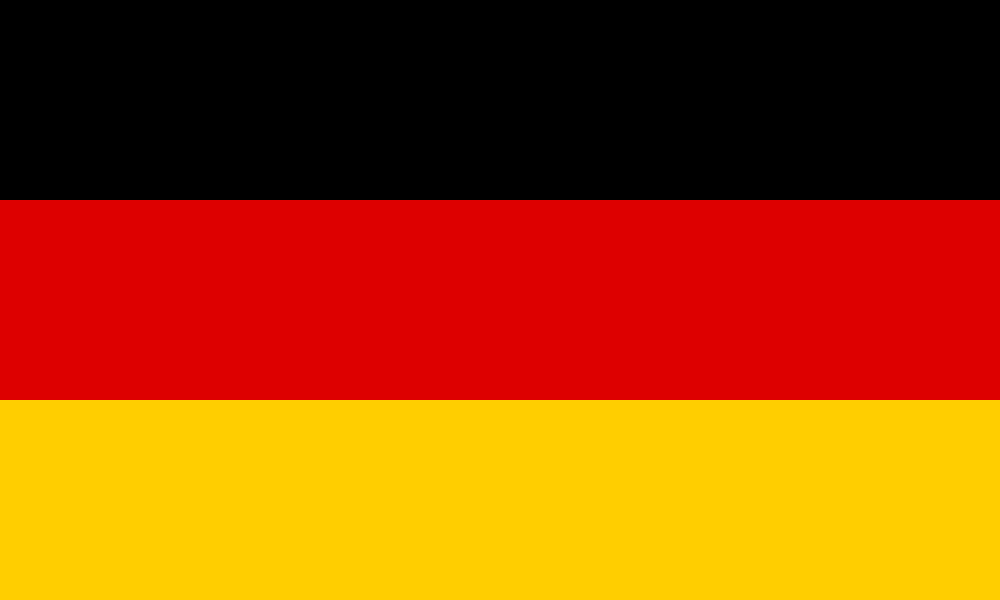
| National colors | black, red, yellowCIA World Factbook [2025] · 2026 archive |
| Citizenship rules | citizenship by birth: no; citizenship by descent only: at least one parent must be a German citizen or a resident alien who has lived in Germany at least 8 years; dual citizenship recognized: yes, but requires prior permission from government; residency requirement for naturalization: 8 yearsCIA World Factbook [2025] · 2026 archive |
the origin of the name is unclear; it may come from Celtic words meaning "neighboring people," or it may derive from Germanic words meaning either "spear man" or "head man;" the native designation "Deutsch" comes from the Old High German "diutisc" meaning "national"
description: three equal horizontal bands of black (top), red, and gold history: the colors can be traced back to the medieval banner of the Holy Roman Emperor -- a black eagle with red claws and beak on a gold field
Source: CIA World Factbook (Historical Archive — final edition) · CC0 · Edition 2026-05