| Indicator | Value |
|---|---|
| ISO 3166 alpha-2 | HUISO 3166 [2024] |
| ISO 3166 alpha-3 | HUNISO 3166 [2024] |
| Capital | BudapestGeoNames [2024] |
| Continent | EuropeGeoNames [2024] |
| Common name | HungaryCIA World Factbook [2025] · 2026 archive |
| Official name | No authoritative open source found |
| Local name | MagyarorszagCIA World Factbook [2025] · 2026 archive |
| Etymology | the Byzantine Greeks referred to the tribes that arrived on the steppes of Eastern Europe in the 9th century as the "Oungroi," a name that later became "Hungari," which originally meant an "[alliance of] ten tribes;" the Hungarian name Magyarorszag means "Country of the Magyars," which may be derived from the name of the most prominent of the Hungarian tribesCIA World Factbook [2025] · 2026 archive |
| Government type | Parliamentary republicCIA World Factbook [2025] · 2026 archive |
| Independence | 16 November 1918 (republic proclaimed); notable earlier dates: 25 December 1000 (crowning of King STEPHEN I, traditional founding date); 30 March 1867 (Austro-Hungarian dual monarchy established)CIA World Factbook [2025] · 2026 archive |
| National holiday | Saint Stephen's Day, 20 August (1083); note: commemorates the saint's canonization and the transfer of his remains to Buda (now Budapest) in 1083CIA World Factbook [2025] · 2026 archive |
| Head of state | Tamas SULYOK (Pres.)CIA World Leaders [2025] |
| Currency code (ISO 4217) | HUFISO 4217 Currency Codes [2026] |
| Currency | ForintISO 4217 Currency Codes [2026] |
| Administrative subdivisions | 43ISO 3166-2 Subdivisions [2026] |
| Subdivision names | Baranya / Borsod-Abaúj-Zemplén / Budapest / Bács-Kiskun / Békés / Békéscsaba / Csongrád-Csanád / Debrecen / Dunaújváros / Eger / Fejér / Győr / Győr-Moson-Sopron / Hajdú-Bihar / Heves / Hódmezővásárhely / Jász-Nagykun-Szolnok / Kaposvár / Kecskemét / Komárom-Esztergom / Miskolc / Nagykanizsa / Nyíregyháza / Nógrád / Pest / Pécs / Salgótarján / Somogy / Sopron / Szabolcs-Szatmár-Bereg / Szeged / Szekszárd / Szolnok / Szombathely / Székesfehérvár / Tatabánya / Tolna / Vas / Veszprém / Zala / Zalaegerszeg / ÉrdISO 3166-2 Subdivisions [2026] |
| Historical overview | "Research completed September 1989." Supercedes the 1973 ed. of Area handbook for Hungary, coauthored by Eugene K. Keefe [et al.]. Includes bibliographical references (p. 275-301) and index. Also available in digital form.LoC FRD Country Studies [2026] |
| National symbols | Holy Crown of Hungary (Crown of Saint Stephen)CIA World Factbook [2025] · 2026 archive |
| National anthem | title: "Himnusz" (Hymn); lyrics/music: Ferenc KOLCSEY/Ferenc ERKEL; history: adopted 1844CIA World Factbook [2025] · 2026 archive |
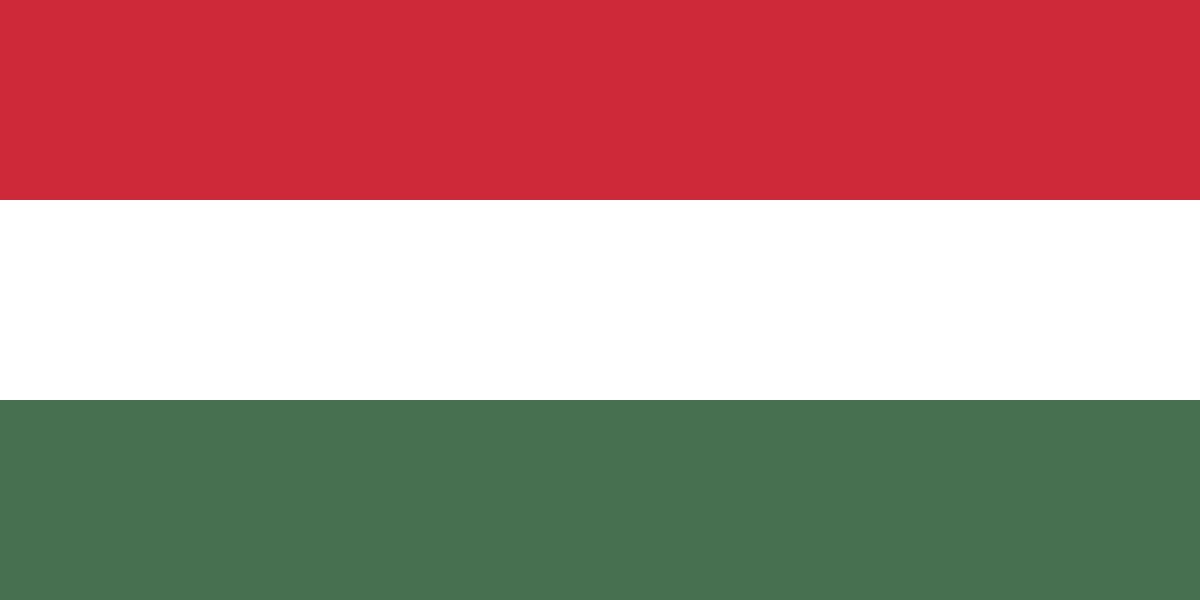
| National colors | red, white, greenCIA World Factbook [2025] · 2026 archive |
| Citizenship rules | citizenship by birth: no; citizenship by descent only: at least one parent must be a citizen of Hungary; dual citizenship recognized: yes; residency requirement for naturalization: 8 yearsCIA World Factbook [2025] · 2026 archive |
the Byzantine Greeks referred to the tribes that arrived on the steppes of Eastern Europe in the 9th century as the "Oungroi," a name that later became "Hungari," which originally meant an "[alliance of] ten tribes;" the Hungarian name Magyarorszag means "Country of the Magyars," which may be derived from the name of the most prominent of the Hungarian tribes
description: three equal horizontal bands of red (top), white, and green meaning: folklore attributes virtues to the colors: red for strength, white for faithfulness, and green for hope; alternatively, the red can stand for the blood spilled in defense of the land, white for freedom, and green for pasturelands history: the flag dates to the national movement of the 18th and 19th centuries and fuses the medieval colors of the Hungarian coat of arms with the revolutionary tricolor of the French flag
Source: CIA World Factbook (Historical Archive — final edition) · CC0 · Edition 2026-05