| Indicator | Value |
|---|---|
| ISO 3166 alpha-2 | KZISO 3166 [2024] |
| ISO 3166 alpha-3 | KAZISO 3166 [2024] |
| Capital | Nur-SultanGeoNames [2024] |
| Continent | AsiaGeoNames [2024] |
| Common name | KazakhstanCIA World Factbook [2025] · 2026 archive |
| Official name | Republic of KazakhstanCIA World Factbook [2025] · 2026 archive |
| Local name | QazaqstanCIA World Factbook [2025] · 2026 archive |
| Etymology | the name may derive from the Turkic word kazak, meaning "nomad;" the Persian suffix -stan means "place of" or "country"CIA World Factbook [2025] · 2026 archive |
| Government type | Presidential republicCIA World Factbook [2025] · 2026 archive |
| Independence | 16 December 1991 (from the Soviet Union)CIA World Factbook [2025] · 2026 archive |
| National holiday | Independence Day, 16 December (1991)CIA World Factbook [2025] · 2026 archive |
| Head of state | Kasym-Zhomart TOKAYEV (Pres.)CIA World Leaders [2025] |
| Currency code (ISO 4217) | KZTISO 4217 Currency Codes [2026] |
| Currency | TengeISO 4217 Currency Codes [2026] |
| Administrative subdivisions | 20ISO 3166-2 Subdivisions [2026] |
| Subdivision names |
|
| Historical overview | No authoritative open source found |
| National symbols | golden eagleCIA World Factbook [2025] · 2026 archive |
| National anthem | title: "Menin Qazaqstanim" (My Kazakhstan); lyrics/music: Zhumeken NAZHIMEDENOV and Nursultan NAZARBAYEV/Shamshi KALDAYAKOV; history: adopted 2006; President Nursultan NAZARBAYEV played a role in revising the lyricsCIA World Factbook [2025] · 2026 archive |
| National colors | blue, yellowCIA World Factbook [2025] · 2026 archive |
| Citizenship rules | citizenship by birth: no; citizenship by descent only: at least one parent must be a citizen of Kazakhstan; dual citizenship recognized: no; residency requirement for naturalization: 5 yearsCIA World Factbook [2025] · 2026 archive |
the name may derive from the Turkic word kazak, meaning "nomad;" the Persian suffix - stan means "place of" or "country"
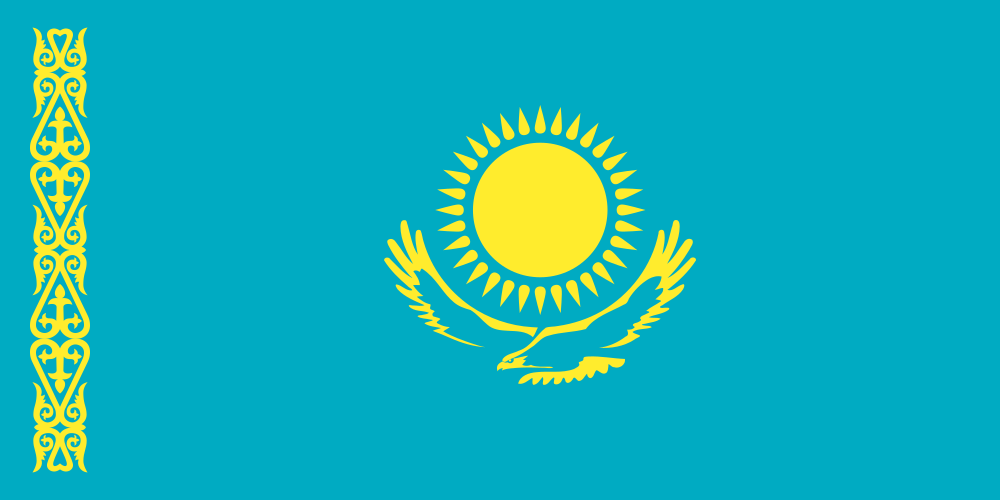
description: a gold sun with 32 rays above a soaring golden steppe eagle, both centered on a sky-blue background; the left side displays a national pattern called koshkar-muiz (the horns of the ram) in gold meaning: the blue color has religious significance for the Turkic peoples and symbolizes cultural and ethnic unity, as well as sky and water; the sun stands for wealth and plenitude, with rays shaped like grain; the eagle has appeared on Kazakh tribal flags for centuries and represents freedom, power, and the flight to the future
Source: CIA World Factbook (Historical Archive — final edition) · CC0 · Edition 2026-05