| Indicator | Value |
|---|---|
| ISO 3166 alpha-2 | NPISO 3166 [2024] |
| ISO 3166 alpha-3 | NPLISO 3166 [2024] |
| Capital | KathmanduGeoNames [2024] |
| Continent | AsiaGeoNames [2024] |
| Common name | NepalCIA World Factbook [2025] · 2026 archive |
| Official name | No authoritative open source found |
| Local name | NepalCIA World Factbook [2025] · 2026 archive |
| Etymology | the name probably comes from the Sanskrit term nepala, from the words for "fly down" and "house," which would refer to the villages at the base of the mountainsCIA World Factbook [2025] · 2026 archive |
| Government type | Federal parliamentary republicCIA World Factbook [2025] · 2026 archive |
| Independence | 1768 (unified by Prithvi Narayan SHAH)CIA World Factbook [2025] · 2026 archive |
| National holiday | Constitution Day, 20 September (2015); note: replaces the previous Republic Day on 28 May as the official national day in Nepal; the Gregorian date fluctuates based on Nepal’s Hindu calendarCIA World Factbook [2025] · 2026 archive |
| Head of state | Ram Chandra POUDEL (Pres.)CIA World Leaders [2025] |
| Currency code (ISO 4217) | NPRISO 4217 Currency Codes [2026] |
| Currency | Nepalese RupeeISO 4217 Currency Codes [2026] |
| Administrative subdivisions | 7ISO 3166-2 Subdivisions [2026] |
| Subdivision names | Bagmati / Gandaki / Karnali / Koshi / Lumbini / Madhesh / SudurpashchimISO 3166-2 Subdivisions [2026] |
| Historical overview | No authoritative open source found |
| National symbols | rhododendron blossomCIA World Factbook [2025] · 2026 archive |
| National anthem | title: "Sayaun Thunga Phool Ka" (Hundreds of Flowers); lyrics/music: Pradeep Kumar RAI/Ambar GURUNG; history: adopted 2007CIA World Factbook [2025] · 2026 archive |
| National colors | redCIA World Factbook [2025] · 2026 archive |
| Citizenship rules | citizenship by birth: yes; citizenship by descent only: yes; dual citizenship recognized: no; residency requirement for naturalization: 15 yearsCIA World Factbook [2025] · 2026 archive |
the name probably comes from the Sanskrit term nepala , from the words for "fly down" and "house," which would refer to the villages at the base of the mountains
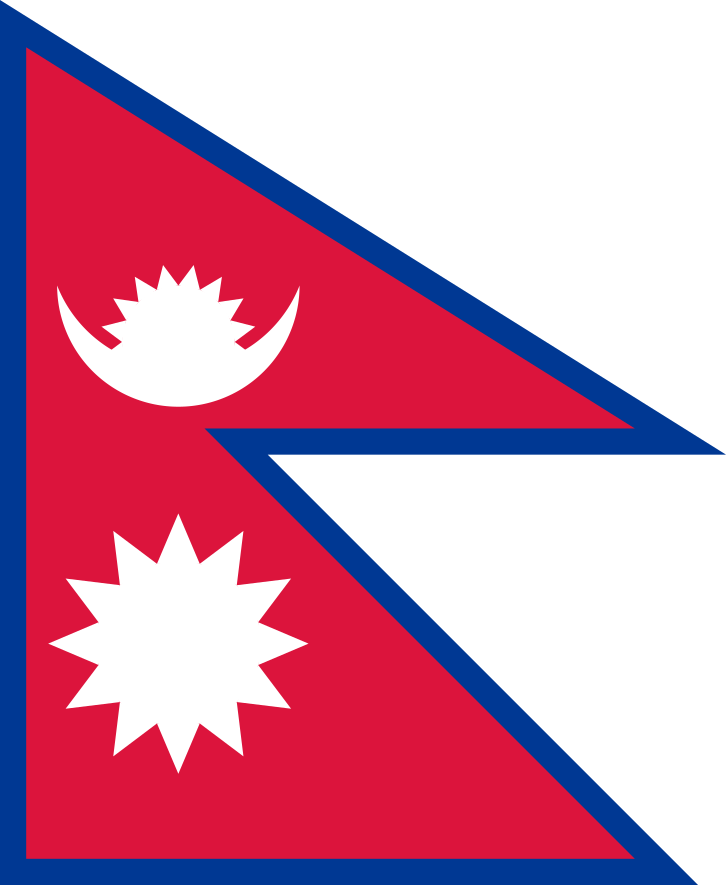
description: crimson red with a blue border, in the shape of two overlapping right triangles; the smaller upper triangle has a stylized white moon, and the larger lower triangle has a 12-pointed white sun meaning: red stands for the rhododendron (the national flower) and victory and bravery, and the blue border for peace and harmony; the two triangles are a combination of two pennants that originally symbolized the Himalaya Mountains, but today they refer to Hinduism and Buddhism, the country's two main religions; the moon stands for the serenity of the people, as well as Himalayan shade and cool weather, and the sun for the heat and higher temperatures in the rest of the country
Source: CIA World Factbook (Historical Archive — final edition) · CC0 · Edition 2026-05