| Indicator | Value |
|---|---|
| ISO 3166 alpha-2 | OMISO 3166 [2024] |
| ISO 3166 alpha-3 | OMNISO 3166 [2024] |
| Capital | MuscatGeoNames [2024] |
| Continent | AsiaGeoNames [2024] |
| Common name | OmanCIA World Factbook [2025] · 2026 archive |
| Official name | Sultanate of OmanCIA World Factbook [2025] · 2026 archive |
| Local name | UmanCIA World Factbook [2025] · 2026 archive |
| Etymology | the origin of the name is uncertain, but it may date back at least 2,000 years, with an "Omana" mentioned by Pliny the Elder (1st century A.D.) and an "Omanon" by Ptolemy (2nd century A.D.); it is said to derive from Oman ben Ibrahim al Khalil (Oman ben Kahtan), who founded the stateCIA World Factbook [2025] · 2026 archive |
| Government type | Absolute monarchyCIA World Factbook [2025] · 2026 archive |
| Independence | 1650 (expulsion of the Portuguese)CIA World Factbook [2025] · 2026 archive |
| National holiday | National Day, 18 November; note: celebrates Oman's independence from Portugal in 1650 and the birthday of Sultan QABOOS bin Said al Said, who reigned from 1970 to 2020CIA World Factbook [2025] · 2026 archive |
| Head of state | HAITHAM bin Tarik Al Said (Sultan)CIA World Leaders [2025] |
| Currency code (ISO 4217) | OMRISO 4217 Currency Codes [2026] |
| Currency | Rial OmaniISO 4217 Currency Codes [2026] |
| Administrative subdivisions | 11ISO 3166-2 Subdivisions [2026] |
| Subdivision names | Ad Dākhilīyah / Al Buraymī / Al Wusţá / Az̧ Z̧āhirah / Janūb al Bāţinah / Janūb ash Sharqīyah / Masqaţ / Musandam / Shamāl al Bāţinah / Shamāl ash Sharqīyah / Z̧ufārISO 3166-2 Subdivisions [2026] |
| Historical overview | No authoritative open source found |
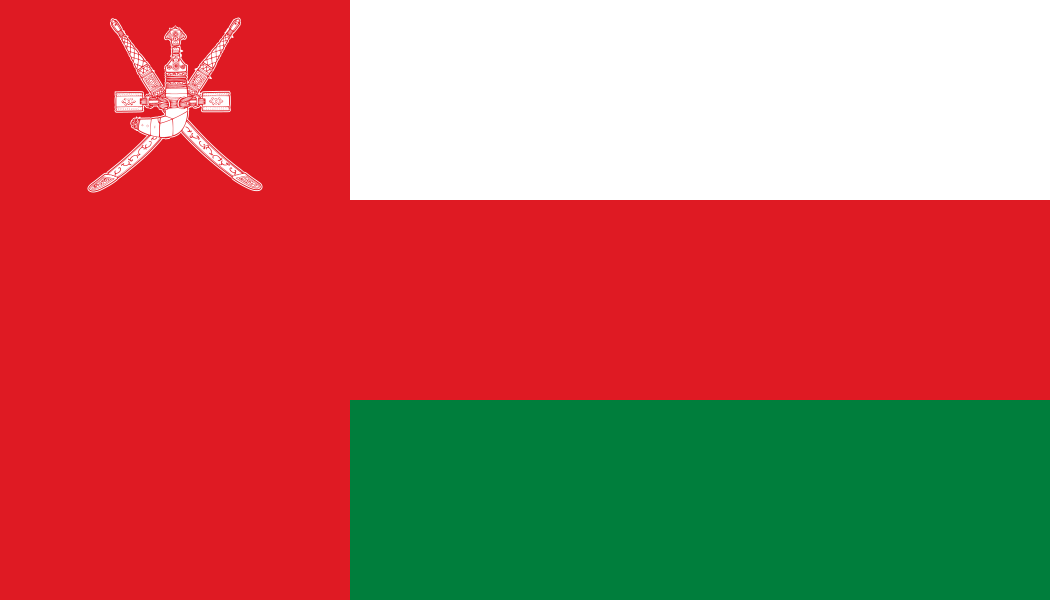
| National symbols | khanjar dagger on top of two crossed swordsCIA World Factbook [2025] · 2026 archive |
| National anthem | title: "Nashid as-Salaam as-Sultani" (The Sultan's Anthem); lyrics/music: Rashid bin Uzayyiz al KHUSAIDI/James Frederick MILLS, arranged by Bernard EBBINGHAUS; history: adopted 1932; new lyrics written after QABOOS bin Said al Said came to power in 1970; first performed by the band of the HMS Hawkins as a salute to the Sultan during a 1932 visit to Muscat; the ship's bandmaster did the arrangementCIA World Factbook [2025] · 2026 archive |
| National colors | red, white, greenCIA World Factbook [2025] · 2026 archive |
| Citizenship rules | citizenship by birth: no; citizenship by descent only: the father must be a citizen of Oman; dual citizenship recognized: no; residency requirement for naturalization: unknownCIA World Factbook [2025] · 2026 archive |
the origin of the name is uncertain, but it may date back at least 2,000 years, with an "Omana" mentioned by Pliny the Elder (1st century A.D.) and an "Omanon" by Ptolemy (2nd century A.D.); it is said to derive from Oman ben Ibrahim al Khalil (Oman ben Kahtan), who founded the state
description: three equal horizontal bands of white (top), red, and green, with a vertical red band on the left side; the national emblem (a khanjar dagger in its sheath on top of crossed swords in scabbards) in white is centered near the top of the vertical band meaning: white stands for peace and prosperity, red for battles against foreign invaders, and green for the Jebel al Akhdar (Green Mountains) and fertility
Source: CIA World Factbook (Historical Archive — final edition) · CC0 · Edition 2026-05