| Indicator | Value |
|---|---|
| ISO 3166 alpha-2 | PHISO 3166 [2024] |
| ISO 3166 alpha-3 | PHLISO 3166 [2024] |
| Capital | ManilaGeoNames [2024] |
| Continent | AsiaGeoNames [2024] |
| Common name | PhilippinesCIA World Factbook [2025] · 2026 archive |
| Official name | Republic of the PhilippinesCIA World Factbook [2025] · 2026 archive |
| Local name | PilipinasCIA World Factbook [2025] · 2026 archive |
| Etymology | named in honor of King PHILLIP II of Spain by Spanish explorer Ruy LOPEZ de VILLALOBOS, who visited the islands in 1543CIA World Factbook [2025] · 2026 archive |
| Government type | Presidential republicCIA World Factbook [2025] · 2026 archive |
| Independence | 4 July 1946 (from the US)CIA World Factbook [2025] · 2026 archive |
| National holiday | Independence Day, 12 June (1898); note: 12 June 1898 was the date of independence from Spain; 4 July 1946 was the date of independence from the USCIA World Factbook [2025] · 2026 archive |
| Head of state | Ferdinand MARCOS, Jr. (Pres.)CIA World Leaders [2025] |
| Currency code (ISO 4217) | PHPISO 4217 Currency Codes [2026] |
| Currency | Philippine PesoISO 4217 Currency Codes [2026] |
| Administrative subdivisions | 17ISO 3166-2 Subdivisions [2026] |
| Subdivision names |
|
| Historical overview | "Research completed June 1991." Supercedes the 1983 ed. of Philippines : a country study, edited by Frederica M. Bunge. Includes bibliographical references (p. 317-359) and index. Also available in digital form.LoC FRD Country Studies [2026] |
| National symbols | three stars and sun, Philippine eagleCIA World Factbook [2025] · 2026 archive |
| National anthem | title: "Lupang Hinirang" (Chosen Land); lyrics/music: collectively/Julian FELIPE; history: music adopted 1898 and lyrics adopted 1956; only sung in TagalogCIA World Factbook [2025] · 2026 archive |
| National colors | red, white, blue, yellowCIA World Factbook [2025] · 2026 archive |
| Citizenship rules | citizenship by birth: no; citizenship by descent only: at least one parent must be a citizen of the Philippines; dual citizenship recognized: no; residency requirement for naturalization: 10 yearsCIA World Factbook [2025] · 2026 archive |
named in honor of King PHILLIP II of Spain by Spanish explorer Ruy LOPEZ de VILLALOBOS, who visited the islands in 1543
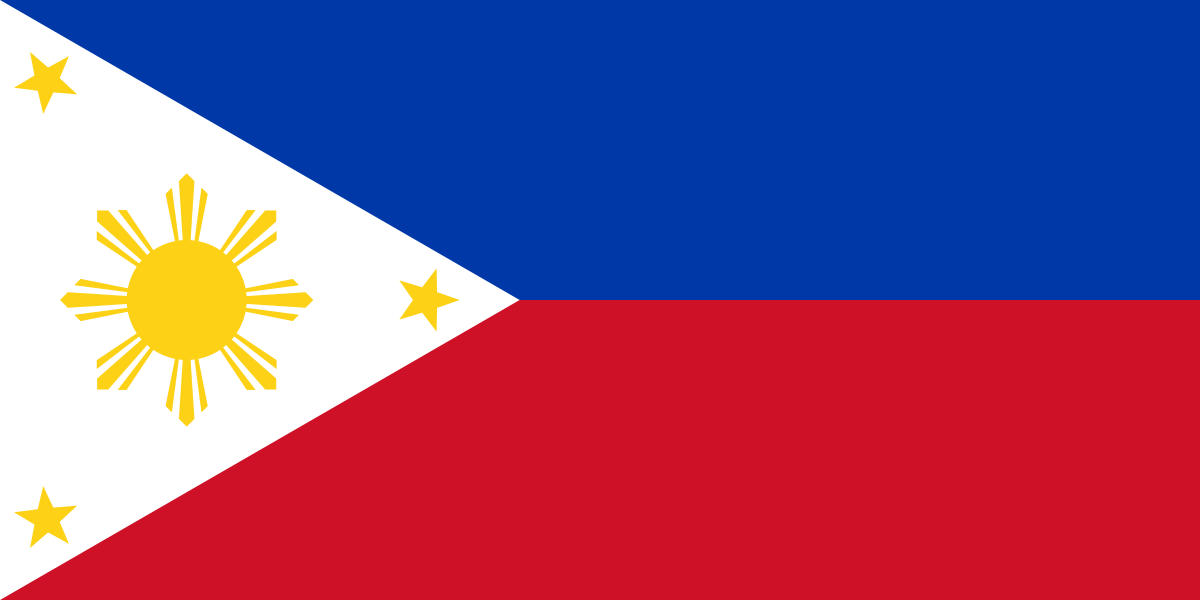
description: two equal horizontal bands of blue (top) and red; a white equilateral triangle is based on the left side; the center of the triangle has a yellow sun with eight rays, each split into smaller rays; the triangle's corners each have a small five-pointed yellow star meaning: blue stands for peace and justice, red for courage, and the triangle for equality; the rays represent the first eight provinces that sought independence from Spain, and the stars represent the country's three parts: Luzon, Visayas, and Mindanao history: the design dates to 1897
Source: CIA World Factbook (Historical Archive — final edition) · CC0 · Edition 2026-05