| Indicator | Value |
|---|---|
| ISO 3166 alpha-2 | KRISO 3166 [2024] |
| ISO 3166 alpha-3 | KORISO 3166 [2024] |
| Capital | SeoulGeoNames [2024] |
| Continent | AsiaGeoNames [2024] |
| Common name | South KoreaCIA World Factbook [2025] · 2026 archive |
| Official name | Republic of KoreaCIA World Factbook [2025] · 2026 archive |
| Local name | Han'gukCIA World Factbook [2025] · 2026 archive |
| Etymology | derived from the Chinese name for Goryeo, which was the Korean dynasty that united the peninsula in the 10th century A.D.; the South Korean name "Han'guk" derives from the long form, "Taehan-min'guk," which is itself a derivation from "Daehan-je'guk," which means "the Great Han Empire"CIA World Factbook [2025] · 2026 archive |
| Government type | Presidential republicCIA World Factbook [2025] · 2026 archive |
| Independence | 15 August 1945 (from Japan)CIA World Factbook [2025] · 2026 archive |
| National holiday | Liberation Day, 15 August (1945)CIA World Factbook [2025] · 2026 archive |
| Head of state | No authoritative open source found |
| Currency code (ISO 4217) | KPWISO 4217 Currency Codes [2026] |
| Currency | North Korean WonISO 4217 Currency Codes [2026] |
| Administrative subdivisions | 17ISO 3166-2 Subdivisions [2026] |
| Subdivision names | Busan-gwangyeoksi / Chungcheongbuk-do / Chungcheongnam-do / Daegu-gwangyeoksi / Daejeon-gwangyeoksi / Gangwon-teukbyeoljachido / Gwangju-gwangyeoksi / Gyeonggi-do / Gyeongsangbuk-do / Gyeongsangnam-do / Incheon-gwangyeoksi / Jeju-teukbyeoljachido / Jeollabuk-do / Jeollanam-do / Sejong / Seoul-teukbyeolsi / Ulsan-gwangyeoksiISO 3166-2 Subdivisions [2026] |
| Historical overview | No authoritative open source found |
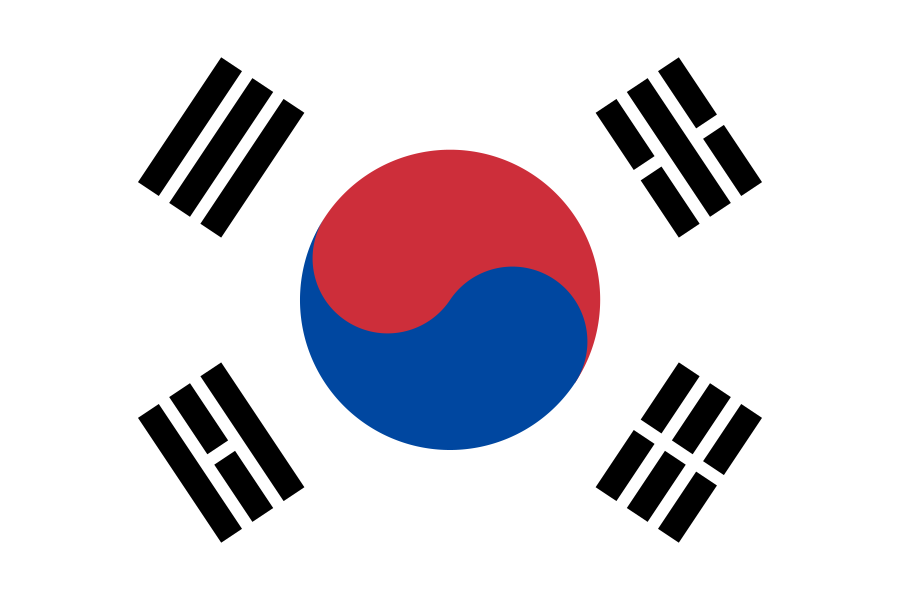
| National symbols | taegeuk (yin-yang symbol), Rose of Sharon (Hibiscus syriacus), Siberian tigerCIA World Factbook [2025] · 2026 archive |
| National anthem | title: "Aegukga" (Patriotic Song); lyrics/music: YUN Ch'i-Ho or AN Ch'ang-Ho/AHN Eaktay; history: adopted 1948, well-known by 1910; North Korea's and South Korea's anthems have the same name and a similar melody, but different lyricsCIA World Factbook [2025] · 2026 archive |
| National colors | red, white, blue, blackCIA World Factbook [2025] · 2026 archive |
| Citizenship rules | citizenship by birth: no; citizenship by descent only: at least one parent must be a citizen of South Korea; dual citizenship recognized: no; residency requirement for naturalization: 5 yearsCIA World Factbook [2025] · 2026 archive |
derived from the Chinese name for Goryeo, which was the Korean dynasty that united the peninsula in the 10th century A.D.; the South Korean name "Han'guk" derives from the long form, "Taehan-min'guk," which is itself a derivation from "Daehan-je'guk," which means "the Great Han Empire"
description: white with a red-and-blue yin-yang symbol in the center; a black trigram ( kwae ) from the ancient I Ching (Book of Changes) is in each corner of the white field meaning: the flag is called Taegukki; white is a traditional Korean color and represents peace and purity; blue stands for the negative cosmic forces of the yin, and red for the opposite positive forces of the yang; each trigram represents one of the universal elements, which together express the principle of movement and harmony
Source: CIA World Factbook (Historical Archive — final edition) · CC0 · Edition 2026-05