| Indicator | Value |
|---|---|
| ISO 3166 alpha-2 | GBISO 3166 [2024] |
| ISO 3166 alpha-3 | GBRISO 3166 [2024] |
| Capital | LondonGeoNames [2024] |
| Continent | EuropeGeoNames [2024] |
| Common name | United KingdomCIA World Factbook [2025] · 2026 archive |
| Official name | United Kingdom of Great Britain and Northern Ireland; note - the island of Great Britain includes England, Scotland, and WalesCIA World Factbook [2025] · 2026 archive |
| Local name | United KingdomCIA World Factbook [2025] · 2026 archive |
| Etymology | the name United Kingdom is self-descriptive; the name Britain probably derives from the Celtic word pretani, meaning "painted people;" the designation of Great Britain for England, Scotland, and Wales dates back to medieval times and was used to distinguish the island from Little Britain, or Brittany, in modern France; the name Ireland evolved from the Gaelic name Eriu, which is possibly derived from the Old Celtic iveriu, meaning "good land"CIA World Factbook [2025] · 2026 archive |
| Government type | parliamentary constitutional monarchy; a Commonwealth realmCIA World Factbook [2025] · 2026 archive |
| Independence | no official date of independence: 927 (minor English kingdoms unite); 3 March 1284 (enactment of the Statute of Rhuddlan uniting England and Wales); 1536 (Act of Union incorporates England and Wales); 1 May 1707 (Acts of Union unite England, Scotland, and Wales as Great Britain); 1 January 1801 (Acts of Union unite Great Britain and Ireland as the United Kingdom of Great Britain and Ireland); 6 December 1921 (Anglo-Irish Treaty formalizes partition of Ireland; six counties become Northern Ireland and remain part of the UK); 12 April 1927 (Royal and Parliamentary Titles Act establishes current name of the United Kingdom of Great Britain and Northern Ireland)CIA World Factbook [2025] · 2026 archive |
| National holiday | the UK does not celebrate one particular national holidayCIA World Factbook [2025] · 2026 archive |
| Head of state | CHARLES III (King)CIA World Leaders [2025] |
| Currency code (ISO 4217) | GBPISO 4217 Currency Codes [2026] |
| Currency | Pound SterlingISO 4217 Currency Codes [2026] |
| Administrative subdivisions | 4ISO 3166-2 Subdivisions [2026] |
| Subdivision names | England / Northern Ireland / Scotland / Wales [Cymru GB-CYM]ISO 3166-2 Subdivisions [2026] |
| Historical overview | No authoritative open source found |
| National symbols | lion (all of Britain); lion, Tudor rose, oak (England); lion, unicorn, thistle (Scotland); dragon, daffodil, leek (Wales); shamrock, flax (Northern Ireland)CIA World Factbook [2025] · 2026 archive |
| National anthem | title: "God Save the King"; lyrics/music: unknown; history: in use since 1745; by tradition, the song serves as both the national and royal anthem; it is known as either "God Save the Queen" or "God Save the King," depending on the gender of the reigning monarch; it also serves as the royal anthem for many Commonwealth nationsCIA World Factbook [2025] · 2026 archive |
| National colors | red, white, blue (all of Britain); red, white (England); blue, white (Scotland); red, white, green (Wales)CIA World Factbook [2025] · 2026 archive |
| Citizenship rules | citizenship by birth: no; citizenship by descent only: at least one parent must be a citizen of the United Kingdom; dual citizenship recognized: yes; residency requirement for naturalization: 5 yearsCIA World Factbook [2025] · 2026 archive |
the name United Kingdom is self-descriptive; the name Britain probably derives from the Celtic word pretani , meaning "painted people;" the designation of Great Britain for England, Scotland, and Wales dates back to medieval times and was used to distinguish the island from Little Britain, or Brittany, in modern France; the name Ireland evolved from the Gaelic name Eriu, which is possibly derived from the Old Celtic iveriu , meaning "good land"
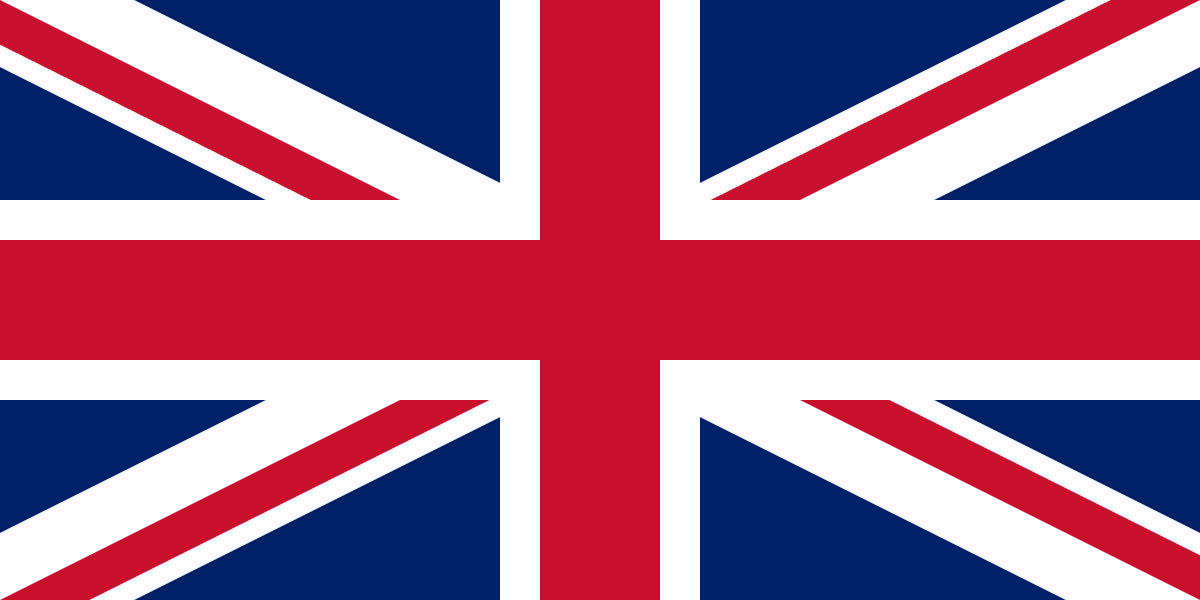
description: blue field with the red cross of Saint George (patron saint of England) edged in white on top of the diagonal red cross of Saint Patrick (patron saint of Ireland), which is on top of the diagonal white cross of Saint Andrew (patron saint of Scotland) history: the official name is the Union Flag, but commonly called the Union Jack; the design and colors have been the basis for a number of other flags
Source: CIA World Factbook (Historical Archive — final edition) · CC0 · Edition 2026-05