| Indicator | Value |
|---|---|
| ISO 3166 alpha-2 | ESISO 3166 [2024] |
| ISO 3166 alpha-3 | ESPISO 3166 [2024] |
| Capital | MadridGeoNames [2024] |
| Continent | EuropeGeoNames [2024] |
| Common name | SpainCIA World Factbook [2025] · 2026 archive |
| Official name | Kingdom of SpainCIA World Factbook [2025] · 2026 archive |
| Local name | EspañaCIA World Factbook [2025] · 2026 archive |
| Etymology | derivation of the name España is uncertain; the Basque words ezpain or espan ("edge," as in a river bank) are possible sources, or the Punic word span, meaning "rabbit;" some academics tie it to the god Hesperus from Greco-Roman mythologyCIA World Factbook [2025] · 2026 archive |
| Government type | Parliamentary constitutional monarchyCIA World Factbook [2025] · 2026 archive |
| Independence | 1492; note: the Iberian peninsula was home to a variety of independent kingdoms prior to the Muslim occupation that began in the early 8th century A.D. and lasted nearly seven centuries; the small Christian redoubts of the north began the reconquest almost immediately, culminating in the seizure of Granada in 1492; this completed the unification of several kingdoms and is traditionally considered the forging of present-day SpainCIA World Factbook [2025] · 2026 archive |
| National holiday | National Day (Hispanic Day), 12 October (1492); note: commemorates the arrival of explorer Christopher COLUMBUS in the AmericasCIA World Factbook [2025] · 2026 archive |
| Head of state | FELIPE VI (King)CIA World Leaders [2025] |
| Currency code (ISO 4217) | EURISO 4217 Currency Codes [2026] |
| Currency | EuroISO 4217 Currency Codes [2026] |
| Administrative subdivisions | 19ISO 3166-2 Subdivisions [2026] |
| Subdivision names |
|
| Historical overview | "Research completed December 1988." Supercedes the 1976 ed. of Area handbook for Spain, coauthored by Eugene K. Keefe [et al.]. Includes bibliographical references (p. 355-384) and index. Also available in digital form.LoC FRD Country Studies [2026] |
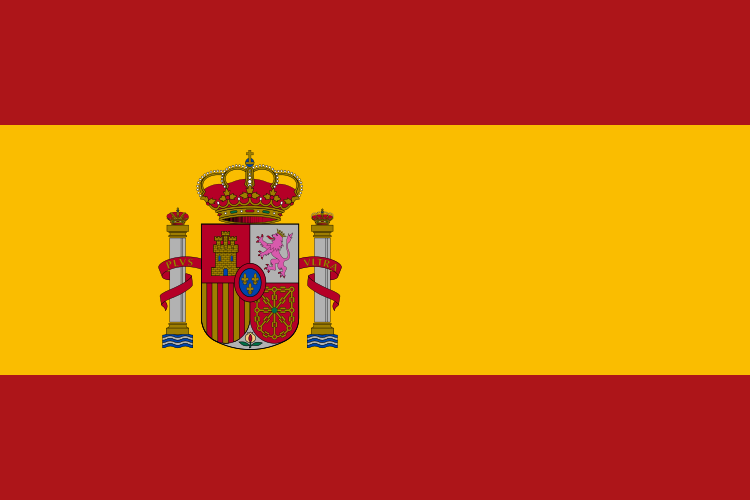
| National symbols | Pillars of HerculesCIA World Factbook [2025] · 2026 archive |
| National anthem | title: "Himno Nacional Espanol" (National Anthem of Spain); lyrics/music: no lyrics/unknown; history: adopted 1942;officially in use between 1770 and 1931, restored in 1939; the Spanish anthem was the first to be officially adopted; it first appeared in a 1761 military bugle-call book and was replaced by "Himno de Riego" in the years between 1931 and 1939; the long version of the anthem is used for the king, and the short version is used for the prince, prime minister, and occasions such as sporting eventsCIA World Factbook [2025] · 2026 archive |
| National colors | red, yellowCIA World Factbook [2025] · 2026 archive |
| Citizenship rules | citizenship by birth: no; citizenship by descent only: at least one parent must be a citizen of Spain; dual citizenship recognized: only with select Latin American countries; residency requirement for naturalization: 10 years for persons with no ties to SpainCIA World Factbook [2025] · 2026 archive |
derivation of the name España is uncertain; the Basque words ezpain or espan ("edge," as in a river bank) are possible sources, or the Punic word span , meaning "rabbit;" some academics tie it to the god Hesperus from Greco-Roman mythology
description: three horizontal bands of red (top), yellow (double-width), and red, with the national coat of arms on the left side of the yellow band; the coat of arms shows the emblems of the area's former kingdoms (clockwise from upper left: Castile, Leon, Navarre, and Aragon), which also used red and yellow as their colors; the stylized pomegranate at the bottom of the shield represents Granada; the two columns represent the Pillars of Hercules, which are promontories (Gibraltar and Ceuta) on the Strait of Gibraltar; a red scroll bears the imperial motto of "Plus Ultra" (further beyond), referring to Spanish lands outside Europe
Source: CIA World Factbook (Historical Archive — final edition) · CC0 · Edition 2026-05