| Indicator | Value |
|---|---|
| ISO 3166 alpha-2 | ZAISO 3166 [2024] |
| ISO 3166 alpha-3 | ZAFISO 3166 [2024] |
| Capital | PretoriaGeoNames [2024] |
| Continent | AfricaGeoNames [2024] |
| Common name | South AfricaCIA World Factbook [2025] · 2026 archive |
| Official name | Republic of South AfricaCIA World Factbook [2025] · 2026 archive |
| Local name | South AfricaCIA World Factbook [2025] · 2026 archive |
| Etymology | self-descriptive name from the country's location on the continent; "Africa" is derived from the Roman designation of the area corresponding to present-day Tunisia "Africa terra," which meant "Land of the Afri" (the tribe resident in that area), but which eventually came to mean the entire continentCIA World Factbook [2025] · 2026 archive |
| Government type | Parliamentary republicCIA World Factbook [2025] · 2026 archive |
| Independence | 31 May 1910 (Union of South Africa formed from four British colonies: Cape Colony, Natal, Transvaal, and Orange Free State); 22 August 1934 (Status of the Union Act); 31 May 1961 (republic declared); 27 April 1994 (majority rule)CIA World Factbook [2025] · 2026 archive |
| National holiday | Freedom Day, 27 April (1994)CIA World Factbook [2025] · 2026 archive |
| Head of state | Matamela Cyril RAMAPHOSA (Pres.)CIA World Leaders [2025] |
| Currency code (ISO 4217) | ZARISO 4217 Currency Codes [2026] |
| Currency | RandISO 4217 Currency Codes [2026] |
| Administrative subdivisions | 9ISO 3166-2 Subdivisions [2026] |
| Subdivision names | Eastern Cape / Free State / Gauteng / Kwazulu-Natal / Limpopo / Mpumalanga / North-West / Northern Cape / Western CapeISO 3166-2 Subdivisions [2026] |
| Historical overview | "Research completed May 1996." Supercedes the 1981 ed. of South Africa : a country study, edited by Harold D. Nelson. Includes bibliographical references (p. 421-483) and index. Also available in digital form.LoC FRD Country Studies [2026] |
| National symbols | springbok (antelope), king protea flowerCIA World Factbook [2025] · 2026 archive |
| National anthem | title: "National Anthem of South Africa"; lyrics/music: Enoch SONTONGA and Cornelius Jacob LANGENHOVEN/Enoch SONTONGA and Marthinus LOURENS de Villiers; history: adopted 1997; a combination of "N'kosi Sikelel' iAfrica" (God Bless Africa) and "Die Stem van Suid Afrika" (The Call of South Africa), which were respectively the anthems of the non-white and white communities under apartheid; official lyrics contain a mixture of Xhosa, Zulu, Sesotho, Afrikaans, and English (the five most widely spoken of South Africa's 11 official languages)CIA World Factbook [2025] · 2026 archive |
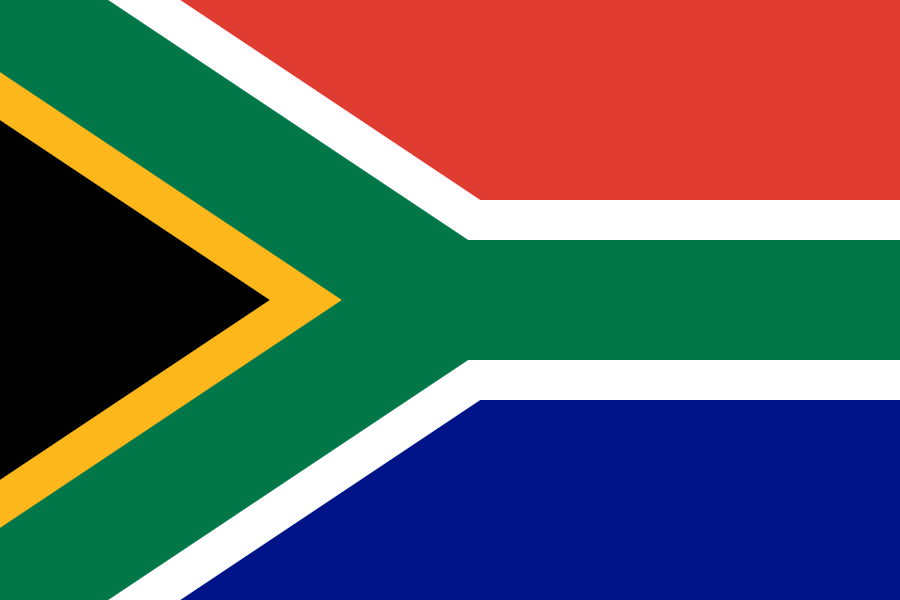
| National colors | red, green, blue, yellow, black, whiteCIA World Factbook [2025] · 2026 archive |
| Citizenship rules | citizenship by birth: no; citizenship by descent only: at least one parent must be a citizen of South Africa; dual citizenship recognized: yes, but requires prior permission of the government; residency requirement for naturalization: 5 yearCIA World Factbook [2025] · 2026 archive |
self-descriptive name from the country's location on the continent; "Africa" is derived from the Roman designation of the area corresponding to present-day Tunisia "Africa terra," which meant "Land of the Afri" (the tribe resident in that area), but which eventually came to mean the entire continent
description: two equal-width horizontal bands of red (top) and blue separated by a central green band that splits into a horizontal Y; a black isosceles triangle is in the Y, with narrow yellow bands around it; the red and blue bands are bordered by narrow white stripes meaning: the colors have no official meaning, but the Y stands for "the convergence of diverse elements within South African society, taking the road ahead in unity"
Source: CIA World Factbook (Historical Archive — final edition) · CC0 · Edition 2026-05